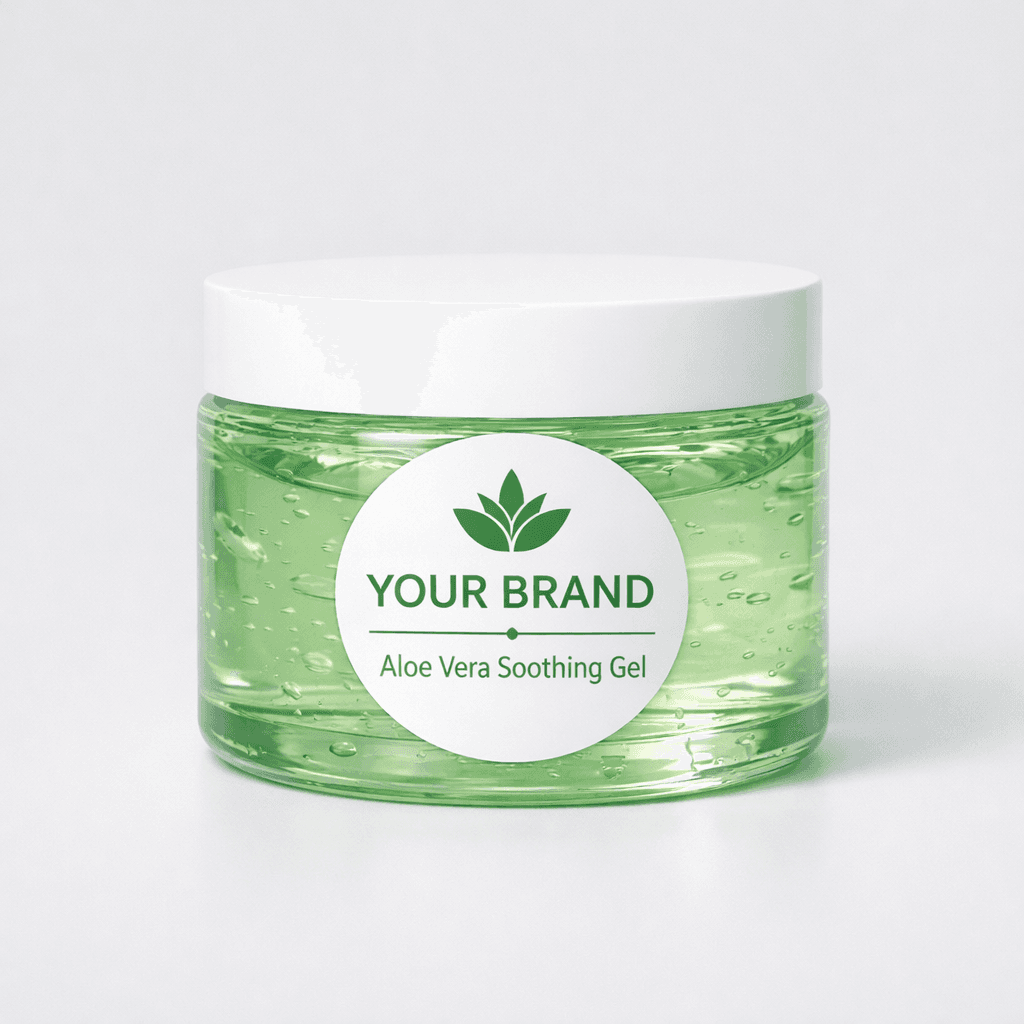
Product opportunity
Is aloe vera soothing gel a good private-label product?
A private label aloe vera soothing gel is defined by more than a large aloe percentage printed on the jar. Buyers need to understand the full formula, the form and declared amount of aloe-derived material, preservation, fragrance, colour, viscosity, skin feel and the evidence behind every cosmetic claim. The gel must also remain stable and compatible with its jar, tube or pump throughout the intended shelf life. A sound sourcing brief separates marketing language from measurable product attributes, locks the final formula and packaging components, and requires qualified testing and destination-market review before branded production is released.
The commercial case
Aloe gels can fit skincare shops, pharmacies, salons, spas, travel ranges and general personal-care brands because consumers recognise the format and use it in simple face and body routines. The category also attracts exaggerated purity, healing and after-sun claims that can create regulatory and reputation risk. Commercial differentiation should come from a pleasant non-sticky texture, controlled fragrance, convenient dispensing, honest ingredient communication and reliable batch quality. The brand should define whether the product is a light daily moisturising gel, a cooling-feel body gel or an after-sun cosmetic, while avoiding language that presents it as a treatment for burns, inflammation or medical conditions.
Market fit
Demand, buyers, and the brand angle
Consumers often compare aloe gels by ingredient story, texture, pack size and value. Clear gels can still contain many supporting ingredients, and green colour does not prove aloe content, so transparent labelling matters. In warm markets, buyers may prefer a fast-spreading gel that does not feel heavy, while salons and body-care users may want larger packs. Sample testing should include different skin preferences and realistic storage conditions. For Nigeria, verify current NAFDAC cosmetic registration, labelling and advertising requirements before import or sale, and ensure formula, claims and artwork remain consistent with the submitted product.
What drives demand
- Aloe gel is a familiar multi-use cosmetic format for lightweight face and body moisturising routines.
- Warm-weather consumers may prefer fast-spreading products that feel lighter than rich creams.
- Multiple pack sizes can serve individual retail, travel, salon and gift-set channels.
- Ingredient-conscious shoppers reward clear formula information and realistic claims.
Likely customer groups
- Skincare, body-care and personal-care brands
- Beauty retailers, pharmacies and online sellers
- Salons, spas and hospitality amenity suppliers
- Travel-size and self-care gift businesses
Recommended white-label angle
Build the white label around a specific and supportable experience: a lightweight face-and-body gel, a fragrance-free positioned formula subject to review, or a cooling after-sun cosmetic without treatment claims. Choose a dispensing format that suits viscosity and hygiene, use restrained ingredient communication and make directions and warnings easy to read. A tamper-evident tube or pump may support portable use, while a jar can suit larger-value packs but requires attention to repeated hand contact. Custom colours and fragrances should be treated as formula changes and evaluated rather than added after approval.
Build the brief
Specifications to settle before requesting quotes
Send every shortlisted supplier the same written brief. That makes quotations comparable and reduces substitutions after sample approval.
- Aloe material
- Identify the aloe-derived ingredient, its form, specification and declared formula level; do not infer finished-product purity from a marketing percentage.
- Complete formula
- Approve the full ingredient composition, formula code, fragrance, colour and prohibited substances, with no substitution without written review.
- Texture and viscosity
- Define appearance, flow, spread, absorption feel, residue and an objective viscosity range measured under stated conditions.
- Preservation and stability
- Request microbiological, preservation and stability work appropriate to the formula, packaging, intended use and proposed shelf life.
- Primary pack
- Choose jar, tube or pump and control material, colour, fill size, closure, liner, seal and dispensing compatibility with the gel.
- Fill control
- Specify net content, acceptable variation, headspace, air-pocket limits and how thick gel will be filled without contamination or inconsistent weight.
- Claims and directions
- Approve supportable cosmetic claims, use instructions and warnings; exclude medicinal burn-healing or disease-treatment language.
- Labelling
- Confirm ingredient declaration, batch and date coding, net content, origin, responsible parties and other destination-market requirements.
Customization ideas
- Clear or lightly tinted gel with a restrained, reviewed fragrance brief
- Hygienic pump or sealed tube for face-and-body positioning
- Full-size and travel-size packs using the same approved formula
- After-sun cosmetic kit paired with a complementary non-medicinal body-care product
Possible market positions
- 1. Lightweight aloe face-and-body gel for warm-weather routines
- 2. Hygienic pump gel with transparent ingredient communication
- 3. Compact travel soothing-gel format with carefully limited cosmetic claims
- 4. Salon-size value pack supported by consistent dispensing and batch controls
Supplier due diligence
Ask better questions. Inspect the answers.
Questions for potential suppliers
- 1What aloe-derived ingredient is used, in what form and at what formula level, and how is that information supported?
- 2Which preservation, microbiological, stability and packaging-compatibility evaluations cover the exact offered formula?
- 3What objective controls apply to viscosity, appearance, odour, pH where relevant, fill weight and batch release?
- 4How are raw materials approved and how will formula, fragrance, colour or preservative changes be communicated?
- 5Can you produce samples with the final gel, pack, seal, label and production filling method?
- 6Which documents can you support for cosmetic registration, compliant labels and product traceability in the destination market?
Quality-control checklist
- Compare gel appearance, odour, spread, residue and dispensing with the retained approved production-equivalent sample.
- Verify formula code, batch identity and agreed release documents, including relevant microbiological and physical checks.
- Measure sampled net contents and inspect headspace, air pockets, separation, particles, contamination and inconsistent viscosity.
- Check closures, liners, pumps, seals, leakage, label adhesion, print durability and tamper evidence after handling tests.
- Confirm ingredient list, claims, directions, warnings, dates, batch code, origin and responsible-party information against approved artwork.
- Evaluate filled packs after agreed storage and transport stresses for colour, odour, separation, viscosity, leakage and component changes.
Protect the order
Risks to resolve before production
Misleading aloe percentage
A percentage may refer to a diluted input or marketing concept rather than pure aloe in the finished formula. Require precise ingredient documentation.
Microbiological instability
A water-rich gel needs an appropriate preservation and manufacturing strategy. Obtain qualified testing for the exact formula and pack.
Texture drift
Viscosity, colour, fragrance or skin feel can change with raw-material and processing variation. Set objective ranges and retain approved samples.
Regulatory or claim mismatch
Cosmetic registration and artwork are market-specific. Complete the applicable NAFDAC process in Nigeria and avoid medical treatment claims.
Shipping and landed-cost planning
Aloe gel is a filled liquid or semi-solid product, so both weight and leak prevention affect landed planning. Request final pack dimensions, filled unit weight, units per carton, carton measurements, gross weight and stacking limits. Tubes can crease or split, jars can loosen or crack, and pumps can unlock during handling unless the retail and master packaging restrain them. Test filled production-equivalent packs in different orientations and after representative vibration, drop and temperature exposure. Protect labels and cartons from moisture and ensure batch records and regulatory shipping documents match the exact formula, pack size and quantities.
Product sourcing FAQ
Questions founders ask before sourcing
Open any question to read the answer.
Can aloe vera gel be produced under a private label?
Yes. The formula, fragrance, colour, texture, pack size, dispenser and artwork can be developed for a brand, subject to testing and destination-market requirements.
Does a high aloe percentage guarantee a better gel?
No. The meaning depends on the aloe ingredient's form and concentration, while preservation, supporting ingredients, stability and skin feel also affect the finished product.
What packaging works for aloe gel?
Jars, tubes and pumps can all work when compatible with the formula. Choose based on viscosity, hygiene, dose control, portability and the intended pack size, then test the filled pack.
Does private label aloe gel need NAFDAC registration in Nigeria?
Cosmetics are regulated in Nigeria. Confirm the current registration, import, labelling and advertising pathway directly with NAFDAC or a qualified adviser.
Can aloe gel be marketed as healing burns?
Avoid medicinal treatment claims unless the product and evidence follow the appropriate regulatory route. Ordinary cosmetic copy should stay within accurate skin-conditioning or moisturising functions.
How can buyers control production consistency?
Freeze the formula and pack, define physical ranges, retain a filled sample, review release documents, inspect net content and packaging, and require approval before changes.