Product opportunity
Is digital blood pressure monitor a good private-label product?
A private label digital blood pressure monitor is a medical device, not an ordinary electronic accessory. Its value depends on measurement performance, the validated device configuration, cuff fit, algorithms, user instructions, component traceability and the regulatory route for the market where it will be sold. A large display and polished enclosure cannot establish accuracy. Buyers should identify the intended user population and use environment, confirm what independent or recognised validation evidence applies to the exact monitor-and-cuff combination, and obtain qualified regulatory advice before ordering branded production. Clinical decisions should remain with healthcare professionals, and product copy must not imply diagnosis or treatment beyond the authorised intended use.
The commercial case
Upper-arm digital monitors can serve pharmacies, medical distributors, clinics, workplace wellness programmes and home-health brands. They address a real monitoring need, but the category carries higher responsibility than general consumer goods. Incorrect cuff sizing, unclear positioning, algorithm changes, component substitutions or poor instructions can produce misleading readings and harm trust. A credible business model prioritises a documented device from a capable manufacturer, accessible support, replacement cuffs, understandable instructions and post-market complaint handling. The lowest unit quotation is not meaningful unless it covers the same validated model, accessories, documentation, quality system, inspection scope and destination-market compliance work.
Market fit
Demand, buyers, and the brand angle
Customers often compare memory capacity, user profiles, display size and power options, while dependable use also relies on correct rest, posture, cuff placement and cuff size. Define whether the offer is for individual home users, couples, older adults or supervised programmes, then design the instructions and accessories around that audience. Do not describe a model as clinically validated without checking the evidence, protocol, population, cuff and exact model reference. In Nigeria, medical devices are regulated and classified by risk; verify the current NAFDAC registration, labelling and advertising requirements for the exact product before import or sale.
What drives demand
- Home monitoring supports people who have been advised by healthcare professionals to track blood pressure between visits.
- Pharmacies and health distributors need accessible upper-arm devices with clear instructions and replacement support.
- Large displays, stored readings and multi-user organisation can make routine measurement easier for households.
- Workplace and community health programmes may require traceable devices and consistent operating guidance.
Likely customer groups
- Licensed medical-device distributors and pharmacies
- Clinics and supervised community health programmes
- Home-health and elder-care product brands
- Workplace wellness providers using appropriately reviewed devices
Recommended white-label angle
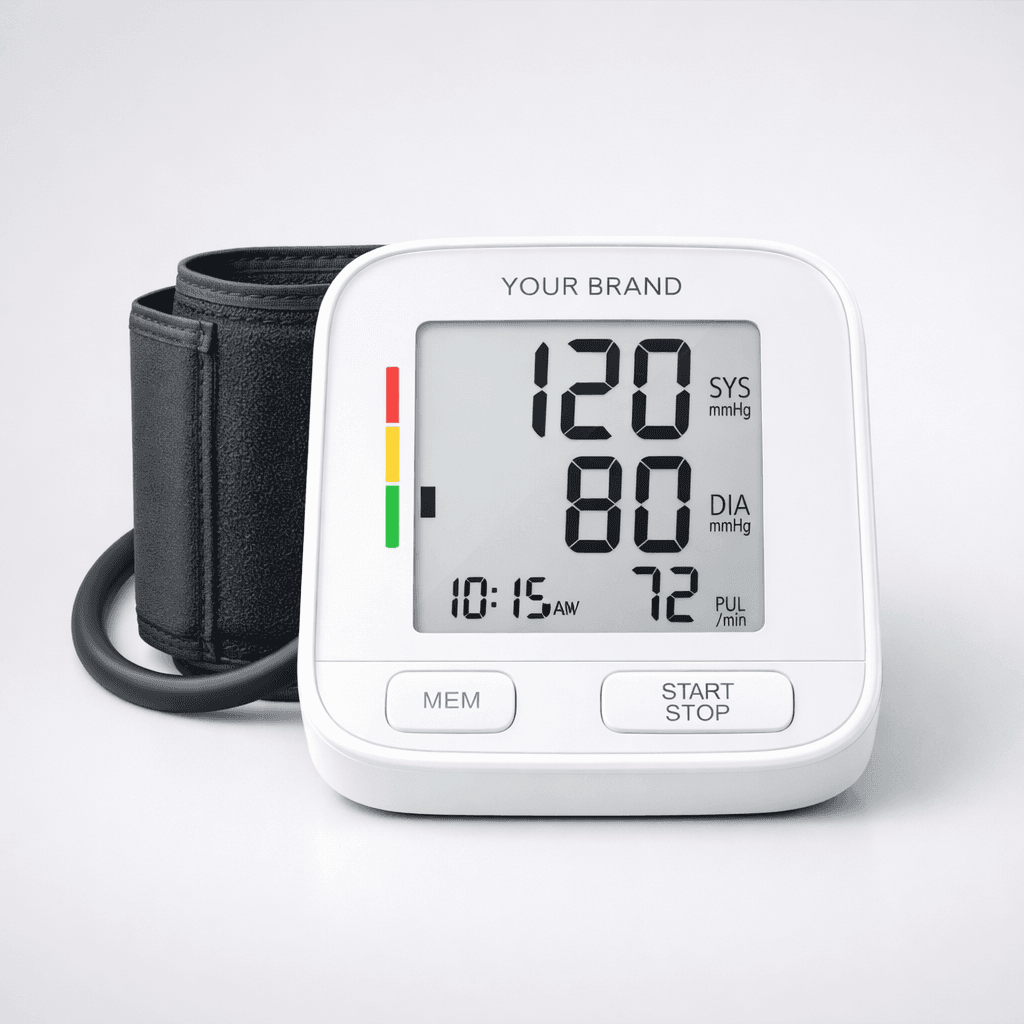
Private labelling should improve clarity and support rather than conceal the original device identity. Use a legible display, high-contrast cuff placement marks, plain-language quick-start guidance, a durable storage bag and accessible customer-support details. The brand, model, manufacturer, responsible parties, identifiers and approved intended use must remain traceable across the device, cuff, carton, instructions and regulatory documentation. Any custom firmware, enclosure, cuff, algorithm, accessories or claims can affect the evaluated configuration, so obtain written confirmation before treating a modified version as equivalent to the supplier's existing evidence.
Build the brief
Specifications to settle before requesting quotes
Send every shortlisted supplier the same written brief. That makes quotations comparable and reduces substitutions after sample approval.
- Intended use
- Define user population, measurement site, environment, operator and exclusions exactly as supported by the manufacturer's device documentation.
- Validation evidence
- Identify the protocol, report, exact model, cuff range and population covered; have a qualified reviewer confirm relevance before making validation claims.
- Cuff system
- Specify arm-circumference range, bladder dimensions, tube and connector, printed placement marks, closure durability and availability of additional cuff sizes.
- Measurement display
- Define displayed systolic, diastolic and pulse values, units, indicators, error messages, digit size and behaviour after an interrupted reading.
- Memory and users
- State user profiles, readings stored, date and time behaviour, averaging method and what happens when memory is full or power is removed.
- Power configuration
- Control battery type, supplied adaptor where applicable, low-power indication, polarity protection and the exact accessories included in each pack.
- Software and algorithm
- Record firmware version and change controls; do not accept an algorithm or component change as equivalent without documented assessment.
- Device identification
- Align model, serial or lot traceability, manufacturer, responsible party, intended use, warnings and required symbols across device and packaging.
Customization ideas
- Brand-colour enclosure accents that do not obscure controls or required markings
- Plain-language quick-start card with illustrated cuff placement
- Durable branded storage pouch with cuff and battery compartments
- Support-led pharmacy pack that clearly identifies replacement cuff options
Possible market positions
- 1. Clear upper-arm home monitor supported by illustrated setup guidance
- 2. Large-display household monitor with organised multi-user memory
- 3. Pharmacy-supported device with replacement cuff and customer assistance
- 4. Traceable programme pack for appropriately supervised wellness initiatives
Supplier due diligence
Ask better questions. Inspect the answers.
Questions for potential suppliers
- 1What exact model, cuff and firmware configuration is covered by the available validation and regulatory documentation?
- 2Which quality-management controls, manufacturing records and change-notification procedures apply to this medical device?
- 3What arm-circumference ranges and cuff sizes are supported, and were those cuffs included in the cited performance evaluation?
- 4How are measurement performance, leakage, display, buttons, memory, power and accessories tested on finished production units?
- 5Which modifications are permitted without invalidating existing evidence, and how will model identity remain traceable after branding?
- 6What documentation can you provide for classification, registration, labelling, complaints, field actions and destination-market review?
Quality-control checklist
- Verify exact model, firmware, cuff, accessories and markings against the approved device master and retained sample.
- Use a qualified inspection plan and calibrated reference equipment to perform the agreed finished-device performance checks.
- Inspect cuff dimensions, bladder position, hook-and-loop closure, stitching, tube, connector and printed placement guide.
- Test display segments, buttons, user selection, date and time, memory, error messages, battery operation and supplied adaptor where applicable.
- Confirm serial or lot traceability, required labels, intended use, warnings, instructions, symbols and responsible-party details.
- Check storage pouch, batteries or adaptor, cuff pack, quick-start guide, carton integrity and quantities across sampled cartons.
Protect the order
Risks to resolve before production
Unsupported accuracy claim
A generic factory report may not cover the exact model, cuff or population. Obtain expert review of relevant validation evidence before making claims.
Cuff mismatch
A cuff outside the user's arm range or different from the evaluated configuration can undermine readings. State the supported range prominently and control substitutions.
Undocumented device changes
Firmware, sensor, pump, valve, cuff or algorithm changes can affect performance. Require formal change notification and assessment.
Regulatory non-compliance
Registration and labelling depend on the exact market and device classification. Complete the applicable NAFDAC and other destination-market process before commercial supply.
Shipping and landed-cost planning
Monitors contain sensitive electronics, a pump system, display and cuff components that should be protected from crushing, moisture and uncontrolled storage conditions. Approve fitted inner packaging, device and cuff placement, carton strength, battery arrangements and any temperature or humidity limits supported by the manufacturer. Request final unit dimensions, gross weight, carton quantities and pallet configuration rather than using a generic medium-product estimate. After transport simulation or representative handling, inspect displays, enclosures, cuff connectors and operation. Ensure shipping documents, model identifiers, serial or lot records and regulatory paperwork describe the same device configuration.
Product sourcing FAQ
Questions founders ask before sourcing
Open any question to read the answer.
Can a blood pressure monitor carry a private label?
It can, but branding does not remove medical-device obligations. The exact device, cuff, firmware, manufacturer and responsible parties must remain traceable and the destination-market route must be completed.
How should a buyer assess a monitor's accuracy claim?
Request evidence for the exact model and cuff, identify the validation protocol and population, and have qualified regulatory or clinical expertise assess whether the evidence supports the intended claim.
Why is cuff size important?
The cuff must suit the user's arm circumference and match the device configuration. Packaging and instructions should make the supported range and correct placement clear.
Does a digital blood pressure monitor need NAFDAC registration in Nigeria?
Medical devices are regulated in Nigeria. Confirm the current classification, registration, import, labelling and advertising requirements directly with NAFDAC and qualified advisers.
What should be inspected before shipment?
Verify the exact model and firmware, cuff construction, agreed performance checks, display and controls, memory, power, accessories, traceability, labelling and carton protection.
Can product copy say the monitor diagnoses hypertension?
Do not expand the authorised intended use. Home readings can support monitoring, but diagnosis and treatment decisions belong with qualified healthcare professionals.