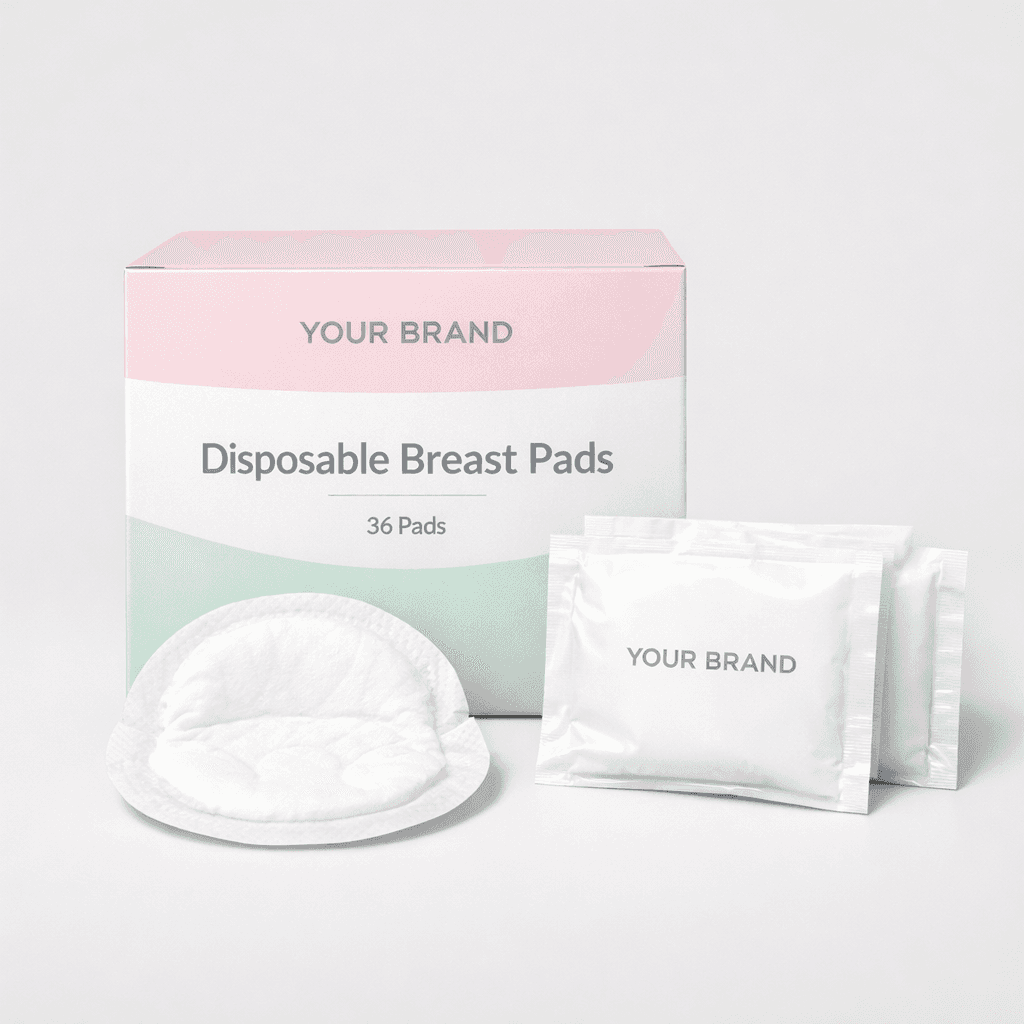
Product opportunity
Is disposable breast pads (36-pack) a good private-label product?
A private label 36-pack of disposable breast pads is a skin-contact absorbent product whose performance depends on the complete layered construction, not simply thickness. The top sheet should feel comfortable, the acquisition and absorbent core should spread and retain liquid, the back layer should resist leakage, and the pad should stay discreetly in place without leaving troublesome adhesive residue. Shape, diameter, edge sealing, individual wrapping and pack hygiene all affect daily use. Buyers should define a realistic absorbency method, skin-contact materials, fit and packaging requirements, then compare production-equivalent samples rather than relying on a supplier's light, medium or high-absorbency label.
The commercial case
Disposable breast pads can serve maternity shops, pharmacies, baby stores, hospitals, ecommerce brands and postnatal gift-box businesses. They address a recurring need during breastfeeding and can encourage repeat purchase when comfort, discretion and absorbency are dependable. The category is sensitive to complaints: pads may bunch, show through clothing, leak at the edge, feel rough, trap moisture or detach from a bra. A credible product is built around controlled materials, consistent absorbent mass, secure edge sealing, appropriate individual wrapping and honest guidance about changing frequency rather than unsupported claims about health outcomes or all-day protection.
Market fit
Demand, buyers, and the brand angle
Nursing mothers may prioritise softness, discretion, pack portability and confidence outside the home. A thinner pad can feel less visible but still needs adequate distribution and retention, while a very thick pad may feel bulky or shift. The 36-count format should state whether it means 36 individual pads or 18 pairs and keep count language consistent across the pouch, carton and ecommerce listing. Test fit and visibility with different bra shapes and users, and do not describe a disposable pad as preventing infection, treating soreness or guaranteeing dryness without an appropriate evidence and regulatory basis.
What drives demand
- Breastfeeding can create an ongoing need for absorbent protection between feeds or pumping sessions.
- Individually wrapped disposable pads are convenient for handbags, work, travel and postnatal kits.
- Maternity and baby retailers can offer pads as a practical replenishment item alongside nursing accessories.
- Reliable fit and discreet construction matter to users wearing different clothing and bra styles.
Likely customer groups
- Maternity, baby-care and pharmacy retailers
- Online postnatal and nursing-accessory brands
- Hospitals, clinics and maternal-support programmes
- Baby-shower, hospital-bag and postnatal gift-box businesses
Recommended white-label angle
Position the product as a thoughtfully specified everyday maternity essential. Use calm, clear packaging, individually wrapped pads, visible front-and-back orientation and concise disposal and changing instructions. Branding can appear on the outer pouch, wrappers and information insert while the pad itself remains simple and comfortable. A travel sub-pack or postnatal kit can add utility, but the primary value must remain consistent absorbency, fit and hygiene. Claims such as breathable, hypoallergenic or dermatologically tested should appear only when the exact materials and finished product have suitable supporting evidence.
Build the brief
Specifications to settle before requesting quotes
Send every shortlisted supplier the same written brief. That makes quotations comparable and reduces substitutions after sample approval.
- Pad count
- Define 36 individual pads or 18 pairs and control the count statement on every packaging and sales channel.
- Top-sheet material
- Specify fibre or nonwoven type, surface feel, colour, treatment and any evidence required for skin-contact claims.
- Absorbent construction
- Record acquisition layer, absorbent materials, core mass and distribution, with no unapproved substitution between pulp and absorbent polymer components.
- Backsheet
- Define material, liquid resistance, flexibility, noise, opacity and any claimed vapour or air permeability supported by testing.
- Shape and dimensions
- Set diameter or contour, thickness, formed cup depth, edge width and tolerances before comparing fit and discretion.
- Adhesive system
- Control strip count, size, position, peel paper, holding method and acceptable residue after removal from representative fabrics.
- Edge sealing
- Specify seal pattern and strength so layers stay aligned and absorbed liquid does not escape through weak or open edges.
- Individual and outer pack
- Approve wrapper seal, opening method, lot traceability, moisture protection, outer pouch closure, directions and disposal information.
Customization ideas
- Individually branded wrappers in a discreet portable outer pouch
- Contoured pad with clearly marked garment-facing side
- Hospital-bag mini pack and full 36-count replenishment pack
- Postnatal essentials kit paired with unrelated products only after separate suitability review
Possible market positions
- 1. Individually wrapped 36-pad everyday maternity pack
- 2. Contoured discreet pad with clearly documented absorbency testing
- 3. Portable hospital-bag format paired with a full replenishment pouch
- 4. Pharmacy-led nursing essential with clear use and disposal guidance
Supplier due diligence
Ask better questions. Inspect the answers.
Questions for potential suppliers
- 1What materials and basis weights are used in the top sheet, acquisition layer, absorbent core and backsheet?
- 2How is absorbency, acquisition time, rewet, retention and edge leakage tested on the finished pad under defined conditions?
- 3What dimensions, core mass, formed shape, edge seal and adhesive tolerances apply to production?
- 4Which skin-contact, chemical, microbiological or claim-support documents apply to the exact materials and finished construction?
- 5How are pads handled, wrapped, counted and lot-coded to control hygiene and traceability during manufacture?
- 6Can you provide production-equivalent samples and retained references from the exact material stack and packaging line?
Quality-control checklist
- Verify individual pad count, dimensions, formed shape, thickness, finished weight and absorbent-core distribution against the specification.
- Inspect top-sheet softness, wrinkles, exposed core, contamination, layer alignment, edge seals and backsheet defects.
- Run the agreed absorbency, acquisition, rewet, retention and edge-leakage comparisons using a consistent test method.
- Check adhesive-strip position, peel-paper removal, hold on representative fabrics and residue after removal.
- Inspect individual wrapper seals, ease of opening, outer pouch closure, moisture damage, lot code and pack count.
- Confirm claims, directions, changing and disposal guidance, warnings, manufacturer or responsible-party details and traceability against approved artwork.
Protect the order
Risks to resolve before production
Uncontrolled absorbent-core changes
Similar-looking pads can contain different core mass or distribution. Freeze the layer construction and compare production by weight and performance.
Rewet and skin discomfort
A pad may absorb liquid but return moisture to the surface under pressure. Include a defined rewet check and assess contact feel.
Weak fit or adhesive
Poor shape and strip placement can cause bunching or movement. Evaluate different bra fabrics and fits rather than a flat laboratory surface alone.
Unsupported sensitive-skin claims
Terms such as hypoallergenic or dermatologically tested require suitable evidence for the exact finished product and should not imply zero risk of irritation.
Shipping and landed-cost planning
Disposable breast pads are light but bulky and must remain dry, clean and correctly counted. Final freight estimates should use the approved compressed or uncompressed pouch, individual wrapper, units per carton, master-carton dimensions and gross weight. Excessive compression can flatten formed pads, crease adhesive liners or damage wrapper seals, while humidity can affect packaging and absorbent materials. Use sealed inner packs and suitable carton protection, and inspect samples from multiple cartons after representative handling for shape recovery, moisture, contamination, wrapper integrity, count and absorbency performance.
Product sourcing FAQ
Questions founders ask before sourcing
Open any question to read the answer.
Does a 36-pack mean 36 breast pads or 36 pairs?
It should be defined explicitly. A 36-pad pack normally represents 18 pairs, but the count statement must remain clear and consistent across all packaging and listings.
How should disposable breast-pad absorbency be compared?
Use a consistent method covering acquisition, total uptake, liquid retention, rewet under pressure and edge leakage rather than relying on a supplier's absorbency label.
Why are breast pads individually wrapped?
Individual wrappers help keep unused pads clean and make them easier to carry. Check wrapper seals, opening, material and lot traceability.
What makes a breast pad discreet?
Diameter, contour, thickness, edge profile, material softness and the way it stays in place all affect visibility and feel under clothing.
Can the packaging claim hypoallergenic?
Only use that or similar sensitive-skin language when suitable evidence supports the exact materials and finished pad; no product can guarantee that irritation will never occur.
How can a buyer control pad quality?
Freeze the layered construction, dimensions, core mass, adhesive and packaging, retain a sample, test production performance and inspect hygiene, seals and count.