Product opportunity
Is dual-compartment insulated lunch bag a good private-label product?
A dual-compartment insulated lunch bag serves office workers, students, families, meal-prep customers and outdoor users who want food organised and easier to carry. Two sections can separate containers from drinks, snacks or utensils, but the commercial value depends on much more than the compartment count. Fabric durability, insulation thickness, liner safety, seam construction, zipper quality, cleanability and thermal performance must all be defined before a supplier can quote accurately.
The commercial case
This is a practical, visible product with opportunities in retail, school supplies, fitness, employee wellness, gifting and meal-prep brands. A well-designed bag can support a higher retail price through strong shape retention, useful capacity, leak-resistant lining and comfortable carry options. Because customers use it daily, weak zippers, persistent odour, torn handles or leaking seams quickly generate complaints.
Market fit
Demand, buyers, and the brand angle
Entry-level bags usually use lighter polyester, basic foam and simple printed branding. Mid-range products improve outer fabric, liner, insulation, reinforcement and pockets. Premium models can add welded liners, higher thermal targets, structured panels, premium hardware, detachable straps or recycled-material stories supported by documentation. Design around the actual meal containers and commute time of the target customer.
What drives demand
- Workers and students carry meals to manage cost, convenience and dietary preferences.
- Meal preparation, fitness and employee-wellness programmes create demand beyond school lunch use.
- Dual compartments help organise different foods and reduce pressure on containers.
- A reusable branded bag can serve both retail and high-volume corporate gifting channels.
Likely customer groups
- Office workers, students and commuters
- Parents buying school meal carriers
- Meal-prep, fitness, kitchenware and lifestyle brands
- Corporate wellness, employee-gift and promotional-product buyers
Recommended white-label angle
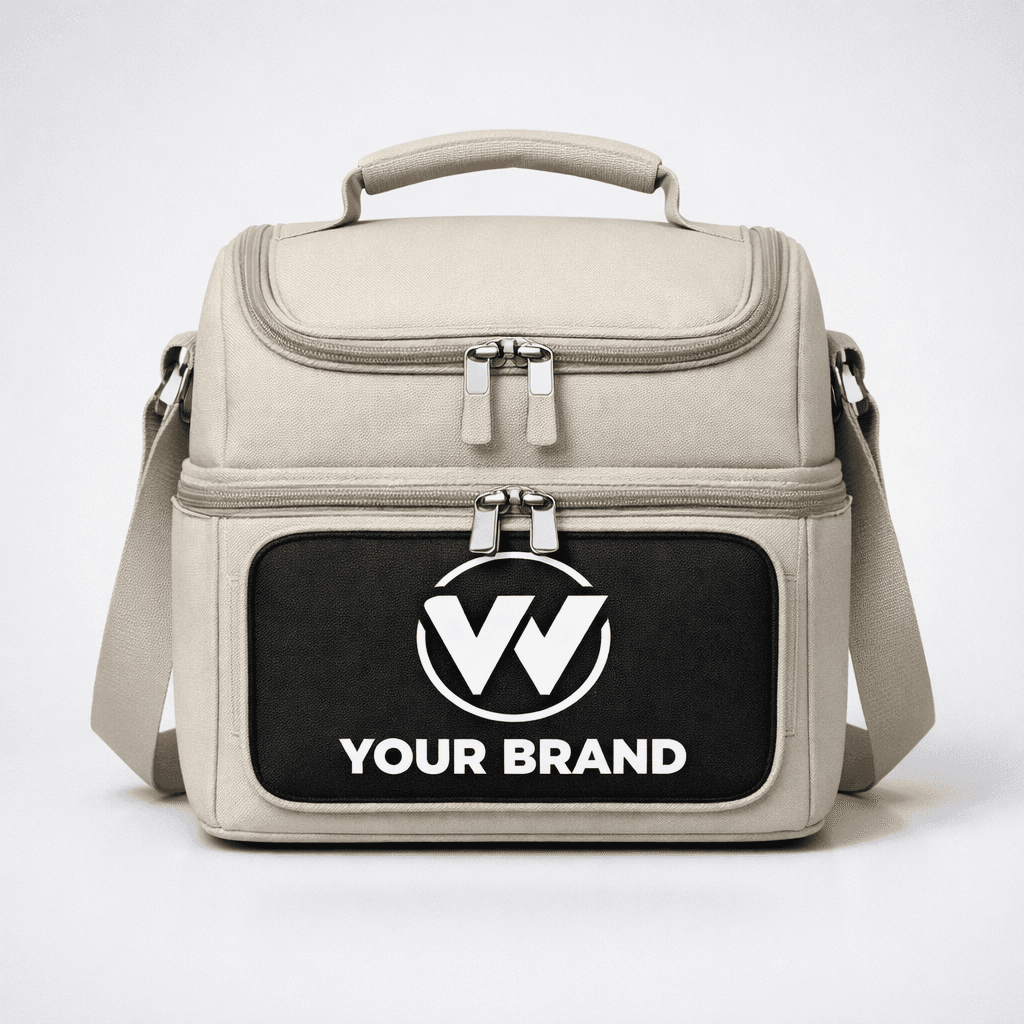
Position the bag as a complete daily meal-carry system. Define one compartment for containers and another for drinks, snacks or accessories, then add an ice-pack sleeve, utensil loop or bottle pocket where useful. Use a front panel with enough uninterrupted area for strong branding and package the product with care instructions or a meal-planning insert.
Build the brief
Specifications to settle before requesting quotes
Send every shortlisted supplier the same written brief. That makes quotations comparable and reduces substitutions after sample approval.
- Capacity and dimensions
- Define external and usable internal dimensions around real containers, bottles and ice packs.
- Outer fabric
- Specify polyester, nylon, Oxford, canvas or another material with denier, coating, colour and abrasion target.
- Insulation
- State foam type, thickness and construction, then define a realistic thermal test rather than accepting an unsupported hour claim.
- Inner lining
- Confirm PEVA, foil, TPU or coated fabric composition, thickness, odour expectations, cleanability and destination-market documentation.
- Compartments
- Define each chamber's dimensions, insulation continuity, divider, opening direction and intended use.
- Leak resistance
- Specify whether seams are stitched, bound or welded and agree a test that matches the intended use.
- Hardware and carry
- Define zipper size, pullers, handle reinforcement, shoulder strap, clips and maximum loaded weight.
- Branding and packaging
- Set logo process, imprint area, labels, care instructions, pack method and carton compression limits.
Customization ideas
- Screen print, embroidery, woven label or branded rubber patch on the front panel
- Pantone-matched fabric, zipper tape, lining and pullers
- Bottle pocket, utensil loop, ice-pack sleeve or detachable shoulder strap
- School, office, fitness and corporate-gift editions using one tested base construction
Possible market positions
- 1. An organised office lunch system for long commutes
- 2. A school-ready bag sized around common containers and bottles
- 3. A meal-prep and fitness bag with ice-pack and utensil storage
- 4. A branded employee-wellness gift with bottle or food-container bundle
Supplier due diligence
Ask better questions. Inspect the answers.
Questions for potential suppliers
- 1What are the exact outer fabric, insulation and liner materials and thicknesses?
- 2What thermal-retention test do you use, with what starting temperature, load and room conditions?
- 3Are the compartment walls fully insulated, and how are liner seams constructed?
- 4Which documents support material and food-contact claims for our destination market?
- 5What loaded-weight, zipper-cycle, handle-pull and leak tests will be applied to production?
- 6Can we approve the bag using our real meal containers before freezing dimensions and bulk production?
Quality-control checklist
- Measure external dimensions, usable compartment size and finished weight.
- Inspect fabric, coating, liner, foam, reinforcement, piping, stitching and shape symmetry.
- Run the agreed temperature-retention test using a consistent load and test method.
- Check liner seams and corners for leakage, cracking, punctures and persistent odour.
- Cycle zippers and load-test handles, strap anchors and clips.
- Verify logo placement, colour, care label, barcode, pack shape and carton-compression protection.
Protect the order
Risks to resolve before production
Unsupported thermal claims
Statements such as 'keeps food cold all day' are meaningless without a defined test, load and ambient condition.
Liner odour or cracking
Cheap or poorly stored lining can smell, crease permanently or fail at corners after limited use.
Weak load-bearing seams
Handles and shoulder anchors may detach when a full bag is carried unless reinforcement is specified and tested.
Poor compartment usability
A two-tier design can look attractive but fail to fit common containers. Validate the layout with real items.
Shipping and landed-cost planning
Insulated lunch bags are often highly volumetric because foam and structured panels resist compression. Request packed-unit and master-carton dimensions for the final construction, then compare safe nesting or limited compression options. Over-compression can crease insulation, deform panels and damage print or piping, so the cheapest carton arrangement may create quality problems on arrival.
Product sourcing FAQ
Questions founders ask before sourcing
Open any question to read the answer.
Can insulated lunch bags be private labelled?
Yes. Outer colours, prints, embroidery, patches, labels, zipper pullers, lining, pockets, straps and packaging can be customised, subject to order quantity and construction.
What materials are used in an insulated lunch bag?
A typical construction combines an outer textile, a foam insulation layer and a cleanable inner liner. The exact fabric, foam and liner should be specified with thickness and supporting documentation.
How long will a custom lunch bag keep food hot or cold?
Performance depends on insulation, seams, bag size, food temperature, ice packs, fill level and ambient conditions. Require a defined comparative test instead of relying on a generic duration claim.
Why use two compartments in a lunch bag?
Separate compartments can organise containers, snacks, drinks and utensils, protect softer food from heavy items and support different temperature zones when the construction is designed correctly.
How do I check whether a lunch-bag liner is suitable?
Confirm material composition and destination-market documentation, then assess odour, cleanability, seam construction, leak resistance, folding durability and performance after repeated use.
What should be inspected before insulated lunch bags ship?
Inspect dimensions, materials, insulation, lining, seams, leakage, thermal performance, zipper cycles, loaded handles, straps, logo, labels, packaging and carton protection.