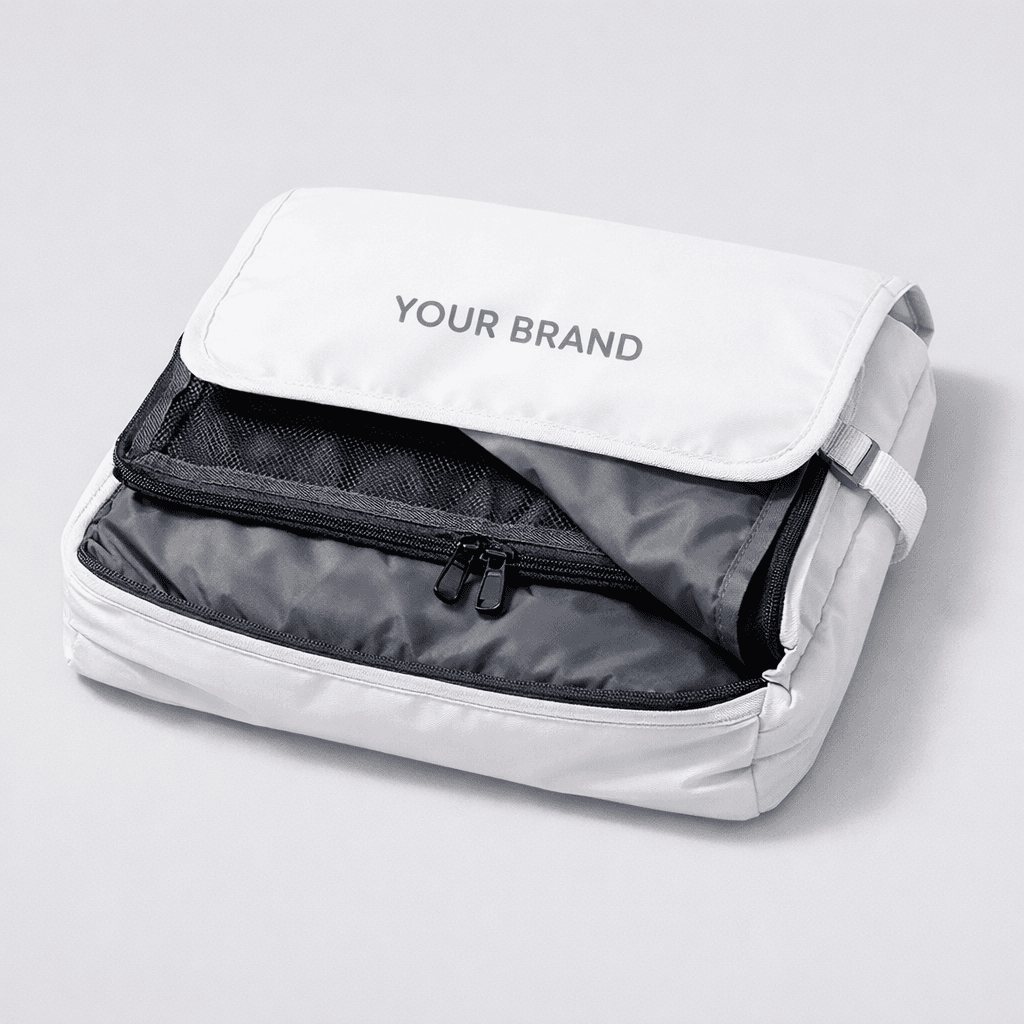
Product opportunity
Is foldable travel laundry bag a good private-label product?
A foldable travel laundry bag solves a simple but persistent packing problem: keeping worn clothing separate without surrendering valuable luggage space when the bag is empty. A credible white-label version must do more than carry a logo. Buyers should define usable capacity, finished dimensions, fabric construction, resistance to damp garments, closure style, seam strength, handle design and the exact way the bag folds or packs into itself. Samples should be loaded with realistic clothing, repeatedly opened and folded, and placed inside representative luggage before a supplier quotation is treated as comparable.
The commercial case
This product can serve travellers, students, gym users, hospitality guests, uniformed workers and people living in compact accommodation. It is easy to demonstrate, can be sold alone or added to packing-cube and luggage bundles, and gives a travel brand a practical lower-priced accessory. Commercial success depends on matching capacity and construction to a clear use case rather than purchasing the thinnest available bag. Plan the sales channel, pack presentation, complaint policy, inspection cost and landed dimensions together. A useful specification and retained approval sample will protect repeat orders better than an undefined request for premium fabric.
Market fit
Demand, buyers, and the brand angle
Customers notice whether the bag holds several days of clothing, stands or hangs conveniently, contains odour and dampness reasonably, closes securely and survives being carried when full. Lightweight drawstring styles compete on compactness, while zippered or structured versions can justify a higher position through separation, handles and better containment. Validate demand using the intended audience and bundle context. Review competing dimensions and recurring complaints such as torn drawstrings, weak seams, colour transfer, misleading capacity and awkward folding, then turn those findings into measurable supplier requirements.
What drives demand
- Travellers need a compact way to separate worn and clean clothing.
- Students and shared-house residents carry laundry between locations.
- The bag can be bundled with luggage, packing cubes and gym accessories.
- Visible folding and capacity demonstrations work well in online retail content.
Likely customer groups
- Frequent travellers, students and gym users
- Luggage and travel-accessory retailers
- Hotels, tour operators and corporate-gifting teams
- Online organisation and lifestyle brands
Recommended white-label angle
Build the offer around a named travel routine: weekend trips, student laundry, gym separation, family luggage or hotel use. Branding can include a woven label, screen print, heat transfer, custom drawcord, zipper pull, colour system and illustrated folding sleeve. A self-storing pocket can add value only if it is intuitive and does not weaken the load-bearing area. Approve the physical colour, fabric hand feel, print durability, packed size, care wording and barcode on one complete sample. Lock these details in the purchase order and require written approval before any fabric, cord, toggle or packaging substitution.
Build the brief
Specifications to settle before requesting quotes
Send every shortlisted supplier the same written brief. That makes quotations comparable and reduces substitutions after sample approval.
- Finished size and capacity
- State flat and usable dimensions, opening size and a practical test load instead of relying only on an unverified litre claim.
- Body fabric
- Define fibre, weave or knit, fabric weight, coating if any, opacity, odour, colourfastness and resistance to tearing and abrasion.
- Moisture management
- Decide whether the bag should breathe or resist damp transfer, then specify the construction and claims accordingly without calling it waterproof unless tested.
- Closure
- Control drawcord, toggle, zipper, flap or roll-top dimensions, operation, retention and resistance to snagging clothing.
- Seams and reinforcement
- Specify stitch type, density, seam allowance, edge finishing and reinforcement at handles, openings and self-storage pockets.
- Handle or hanging point
- Define webbing or fabric construction, attachment pattern and load test for carrying or hanging a representative full bag.
- Folded configuration
- Approve the folded dimensions, self-storage method, instructions and the number of fold cycles expected without damage.
- Branding and packaging
- Fix logo process, colour reference, placement, care label, folding method, retail sleeve or pouch and master-carton assortment.
Customization ideas
- Weekend, student, gym and family capacity options
- Colour-coded clean and laundry travel set
- Woven label, durable print or branded self-storage pocket
- Coordinated bundle with packing cubes or shoe bags
Possible market positions
- 1. Compact laundry separation for weekend travel
- 2. Student laundry carrier that folds into its own pocket
- 3. Colour-coded family luggage organisation range
- 4. Travel bundle with packing cubes and shoe storage
Supplier due diligence
Ask better questions. Inspect the answers.
Questions for potential suppliers
- 1What are the finished dimensions, fabric specification and tested load for the exact quoted construction?
- 2How is fabric weight, colourfastness, odour and tear resistance controlled between production lots?
- 3Which seams and attachment points are reinforced, and what load or cycle tests are performed on them?
- 4Is the material breathable, coated or water resistant, and which test supports any moisture-related claim?
- 5Can you produce the approved folding method, branding and retail pack without increasing the final shipping volume unexpectedly?
- 6How are sharp trims, broken stitches, stains, mixed colours and incorrect pack quantities detected before shipment?
Quality-control checklist
- Measure flat size, opening, folded size and component placement against the approved tolerances.
- Load bags with representative clothing and inspect seams, handles, closures and distortion after carrying and hanging.
- Repeat opening, closing and folding cycles on samples selected across the batch.
- Check fabric for holes, coating variation, odour, stains, colour transfer and inconsistent hand feel.
- Test logo adhesion or print durability using the agreed rub and care method.
- Verify labels, colours, folding, retail pack, carton assortment and quantity before release.
Protect the order
Risks to resolve before production
Misleading capacity
Supplier litre claims may not reflect the usable opening or a realistic clothing load, so approve dimensions and a physical fill test.
Seam or handle failure
Thin fabric and unreinforced attachments can fail only after the bag is filled, making loaded inspection essential.
Moisture claim mismatch
A breathable bag, coated bag and genuinely waterproof bag are different products; vague claims create complaints and regulatory exposure.
Excess shipping volume
Poor folding or oversized retail packaging can remove the freight advantage of a lightweight textile item.
Shipping and landed-cost planning
Foldable laundry bags are lightweight, so landed cost can be driven more by packed volume than by gross weight. Confirm the final branded folding method, individual pack dimensions, units per carton, carton dimensions and gross weight using production-equivalent samples. Avoid compression that permanently creases prints, damages coatings, bends toggles or traps moisture and odour. Protect light colours from carton transfer and keep cartons dry throughout storage and transit. Recalculate freight after branding and retail packaging are approved, then inspect carton assortment, markings and bag condition before shipment release.
Product sourcing FAQ
Questions founders ask before sourcing
Open any question to read the answer.
Can a foldable travel laundry bag be white labelled?
Yes. Fabric, dimensions, colour, closure, handles, logo method, labels, folding format and packaging can be specified. Approve the complete branded sample rather than treating the logo as the only customization.
Which fabric is suitable for a travel laundry bag?
The right fabric depends on the intended load, packed weight, breathability and moisture expectations. Compare fibre, construction, weight, coating, tear resistance, colourfastness and odour instead of choosing by material name alone.
How should laundry-bag capacity be checked?
Record finished dimensions and test the opening and body with a representative clothing load. Do not rely on a litre figure unless the supplier explains and reproduces the measurement method.
Should the bag be waterproof?
Not automatically. Breathability may be preferable for worn clothing, while some buyers want resistance to damp transfer. Define the use case and only publish waterproof or water-resistant claims supported by relevant testing.
What commonly fails during production?
Frequent risks include thin or substituted fabric, weak seams, detached handles, failing drawcord hardware, colour transfer, poor print durability and retail packs that contain the wrong colour or quantity.
How should this product be prepared for shipping?
Approve the exact fold and retail pack, measure the final packed volume, protect prints and hardware from crushing, keep cartons dry and confirm carton quantities and assortment before calculating the final landed cost.