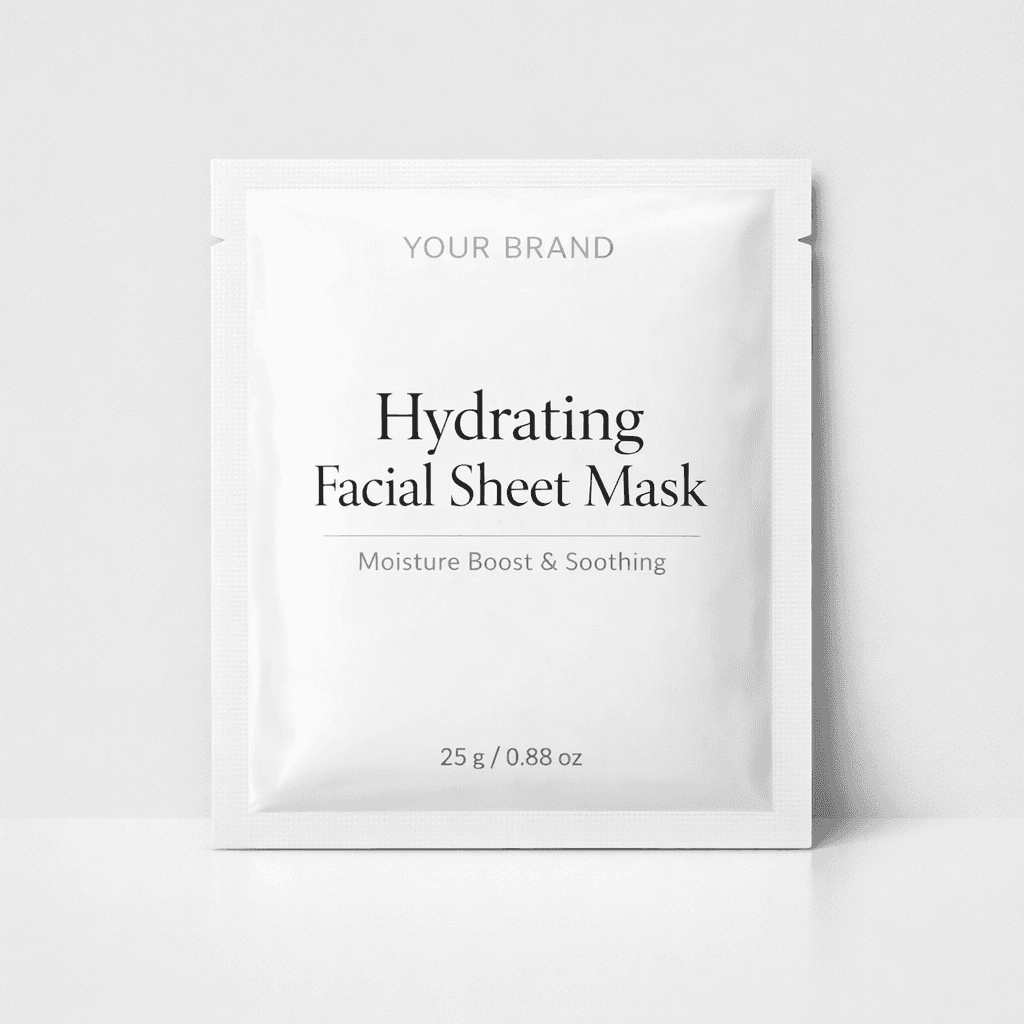
Product opportunity
Is hydrating facial sheet mask a good private-label product?
A private label hydrating facial sheet mask combines a cosmetic serum, a skin-contact substrate and a sealed single-use sachet. All three must work together. A pleasant sample can still fail commercially if serum distribution varies, the sheet tears during unfolding, the eye and mouth openings fit poorly, the preservative system is unsuitable, or the pouch loses moisture in storage. Buyers need a formula-level brief covering the complete ingredient list, intended cosmetic function, texture, fragrance position and preservation, plus measurable controls for sheet material, dimensions, serum fill, seal strength and finished-pack stability. Claims and artwork should only be approved after the exact formula and destination-market regulatory route are understood.
The commercial case
Hydrating sheet masks fit beauty retailers, pharmacies, salons, spas, ecommerce brands and gift-box businesses because they offer a familiar single-use skincare experience and support trial, bundles and routine-based merchandising. The low unit size can encourage impulse purchases, but crowded competition makes generic hydration claims and copied packaging easy to overlook. Stronger brands define a recognisable formula story, comfortable sheet fit, reliable saturation and clear use instructions. Commercial planning should include shelf-life evidence, stock rotation, storage and batch traceability because the finished product contains a water-based cosmetic in prolonged contact with a folded substrate and flexible pouch.
Market fit
Demand, buyers, and the brand angle
Shoppers often compare hero ingredients, fragrance, sheet feel, serum quantity, slipping, residue and whether the mask fits comfortably. Ingredient-led marketing should distinguish the amount and function of an ingredient from its mere presence in a formula. Terms such as dermatologically tested, hypoallergenic, clean, brightening or suitable for sensitive skin require definitions and appropriate support; they should not be treated as decorative phrases. For sale in Nigeria, cosmetics are regulated, so confirm current NAFDAC registration, import, labelling and advertising requirements for the exact formula and claims. Review requirements separately for every additional country rather than assuming one registration applies everywhere.
What drives demand
- Single-use sheet masks provide an accessible trial format for skincare shoppers.
- The format works in beauty routines, travel kits, salon retail, gifting and promotional bundles.
- Recognisable moisturising ingredients give brands clear educational content when claims remain accurate.
- Custom pouch artwork offers strong shelf and social-media visibility in a compact product.
Likely customer groups
- Independent skincare and personal-care brands
- Beauty retailers, pharmacies and ecommerce stores
- Salons, spas and professional treatment-retail programmes
- Subscription boxes, hospitality amenities and self-care gift businesses
Recommended white-label angle
A credible white label sheet mask starts with a controlled formula and production-equivalent filled sachet, not just a catalogue ingredient theme. Brands can customise the substrate, cut pattern, serum sensory profile, fragrance position, pouch finish, carton and routine instructions. Each adjustment can affect compatibility, preservation, dose or user experience, so the final combination should be evaluated together. Position hydration through accurate cosmetic language and useful directions, avoiding treatment claims or guaranteed results. A series can use coordinated packaging and distinct formula codes, but every variant should have its own ingredient declaration, evidence, artwork control and finished-product release specification.
Build the brief
Specifications to settle before requesting quotes
Send every shortlisted supplier the same written brief. That makes quotations comparable and reduces substitutions after sample approval.
- Complete serum formula
- Freeze the formula code, full ingredient composition, raw-material specifications, fragrance and colour, with formal approval for any substitution.
- Physical profile
- Define serum appearance, colour, odour, viscosity, skin feel, residue and pH range where formulation-relevant.
- Microbiological control
- Set appropriate raw-material, bulk and finished-product microbiological limits and preservation evaluation for the serum, substrate and process.
- Sheet substrate
- Specify fibre composition, basis weight, thickness, texture, strength, absorption behaviour and supplier change control.
- Cut and fit
- Control overall mask dimensions, face outline, eye, nose and mouth openings, cut tolerances and folding orientation.
- Serum dose
- State target fill and tolerance per sachet, saturation uniformity and acceptable residual serum without implying that more liquid always means better performance.
- Sachet system
- Specify laminate structure, barrier needs, dimensions, seal width, notch, print, batch code and compatibility with the formula.
- Claims and directions
- Approve supportable cosmetic claims, ingredient list, application time, single-use instruction, warnings, storage, batch and date information.
Customization ideas
- Fragrance-free positioned hydrating formula subject to full formulation review
- Soft plant-derived or other documented substrate chosen for fit and strength
- Premium matte, foil-accent or minimalist sachet within proven barrier specifications
- Coordinated hydration set with facial mist, moisturiser or serum
Possible market positions
- 1. Comfort-fit hydration mask with transparent formula and substrate details
- 2. Fragrance-free positioned self-care mask with restrained cosmetic claims
- 3. Travel-friendly single mask for a simple hydration routine
- 4. Coordinated weekly mask collection with individually controlled formulas
Supplier due diligence
Ask better questions. Inspect the answers.
Questions for potential suppliers
- 1Who owns and manufactures the serum formula, and what controls prevent unapproved ingredient or fragrance substitutions?
- 2What stability, compatibility and microbiological evidence covers the exact serum, sheet, fold, fill and sachet laminate?
- 3What is the substrate composition, supplier and basis weight, and how are changes controlled?
- 4Which release limits apply to pH where relevant, viscosity, appearance, odour, fill, sheet dimensions, seal and microbiological quality?
- 5Can you provide production-equivalent filled sachets and retained samples from a pilot or manufacturing run?
- 6How are serum mixing, sheet dosing, environmental hygiene, metal detection where applicable, sealing and batch traceability controlled?
- 7Which documents support destination-market cosmetic registration, ingredient review, claims and artwork?
Quality-control checklist
- Match formula, bulk batch, substrate lot, sachet laminate and finished batch records to the approved specification.
- Check serum appearance, odour, viscosity, pH where relevant and microbiological results against release limits.
- Measure net fill, serum distribution, sheet mass and mask dimensions across samples from different production points.
- Unfold and apply representative masks to assess tearing, misplaced cuts, rough edges, fit, slipping and inconsistent saturation.
- Test seal continuity, seal strength, notch opening and leakage after representative compression and transport handling.
- Verify ingredient list, claims, directions, warnings, storage, batch and date codes, origin and responsible-party details against approved artwork.
- Review stability samples for drying, discolouration, odour change, separation, pack swelling, leakage and laminate interaction.
Protect the order
Risks to resolve before production
Formula and artwork mismatch
Catalogue artwork may not reflect the final ingredients or formula code. Lock the composition first and generate the label from controlled documents.
Microbiological failure
A water-based serum and wet substrate require suitable formulation and hygienic manufacture. Use qualified preservation and finished-product evaluation.
Moisture loss or leaking sachets
Inadequate laminate, sealing or formula compatibility can dry the mask or soil cartons. Validate the exact filled pack over supported storage conditions.
Unsupported skincare claims
Do not promise treatment, guaranteed brightening or irritation-free use. Claims must suit the cosmetic evidence and authorised market route.
Substrate substitution
A different sheet can change fit, strength, absorption and preservation conditions. Include the substrate supplier and properties in change control.
Shipping and landed-cost planning
Finished sheet-mask sachets are compact but can leak under compression, crease at seals or lose moisture through an unsuitable laminate. Request filled unit weight, pouch and retail-carton dimensions, units per carton, carton gross weight and stacking limits. Pack sachets flat in a consistent orientation without sharp dividers pressing on seal edges. Use secondary cartons and master cases that protect against puncture, excessive compression, moisture and avoidable heat. Perform representative transit and leakage checks on the final filled pack, then examine sachet seals, print, batch codes, serum retention, odour and mask condition. Keep formula, batch, regulatory and shipping documents aligned to the same variant and pack count.
Product sourcing FAQ
Questions founders ask before sourcing
Open any question to read the answer.
Can facial sheet masks be private labelled?
Yes. The serum, sheet material and cut, fill, sachet and artwork can be customised, but the finished combination requires testing, documentation and regulatory review.
What determines sheet mask quality?
Quality depends on the controlled formula, preservation, substrate composition and strength, fit, consistent serum dose, hygienic manufacture, pouch barrier and seal—not one hero ingredient alone.
Do sheet masks need NAFDAC registration in Nigeria?
Cosmetics are regulated in Nigeria. Confirm current registration, import, labelling and advertising requirements directly with NAFDAC or qualified advisers for the exact product.
Can the factory add a popular ingredient to an existing serum?
A formula change can affect stability, preservation, skin feel, claims and the regulatory file. It should be assessed and tested as a revised complete formula.
How should buyers compare sheet materials?
Compare documented fibre composition, basis weight, thickness, strength, absorption, softness, fit and consistency in the final wet product rather than relying on material names alone.
What should be approved before printing sachets?
Approve the final formula, ingredient list, claims, directions, warnings, regulatory route, pouch structure, dimensions and production-equivalent sample before committing to artwork.