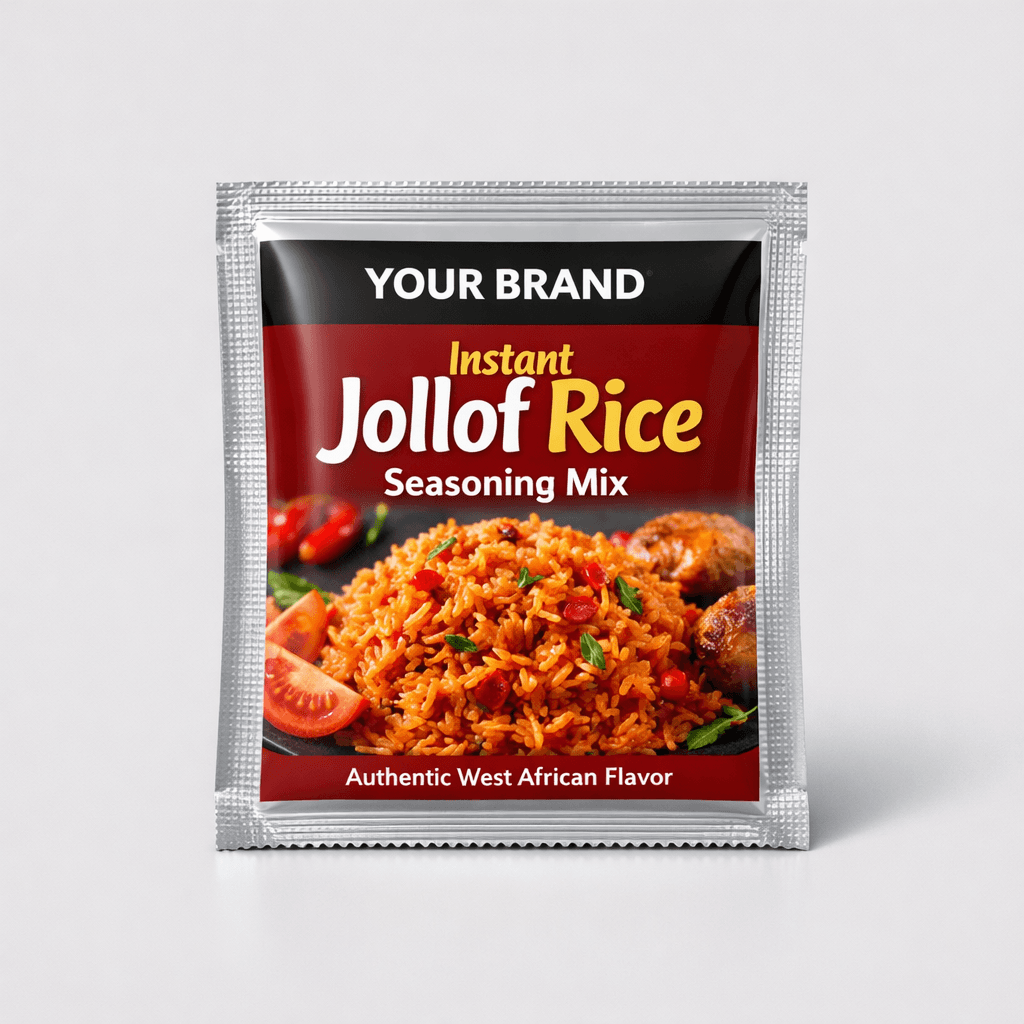
Product opportunity
Is instant jollof rice seasoning mix sachets a good private-label product?
White label jollof rice seasoning sachets sourcing begins with a precise product definition, not a supplier photograph. This product is a portioned dry seasoning blend formulated for a declared quantity of jollof rice, intended for delivering repeatable flavour when used with the labelled recipe and serving quantity. A credible brief must separate required performance from optional branding and must state the destination market before quotations are compared. Importers should align materials, dimensions, components, claims, packaging, test methods and inspection criteria so every supplier prices the same version. The result is a product that can be sampled, checked and reordered against evidence instead of assumptions.
The commercial case
Jollof Rice Seasoning Sachets can work as a focused branded product when the offer solves a recognisable customer problem and the quality promise is easy to explain. Likely routes to market include African grocery brands, supermarkets and wholesalers, caterers and food-service suppliers, with repeat or referral demand depending on durability, usability and category. Commercial evaluation should include the complete landed unit: product, branding, packaging, tests, inspection, freight, duties and an allowance for defects or returns. Start with a tightly controlled version, learn from customer feedback, and add variants only when the original specification performs consistently.
Market fit
Demand, buyers, and the brand angle
Searchers considering jollof rice seasoning sachets usually want to understand supplier reliability, customisation, minimum order implications, quality risks and import practicality—not merely see a catalogue image. Compare competitor complaints, review how buyers describe the problem, and test whether the proposed feature set is meaningful in Nigeria and the intended sales channel. Avoid copying marketplace superlatives. A narrower promise supported by a clear specification, useful instructions and consistent production is more defensible than an overloaded product with unverified features.
What drives demand
- A clear everyday or specialist use case: delivering repeatable flavour when used with the labelled recipe and serving quantity.
- Brand differentiation through mild, hot or smoky flavour profile.
- Sales potential across African grocery brands, supermarkets and wholesalers and related channels.
- Buyers increasingly compare practical specifications, instructions and verified quality rather than relying only on appearance.
Likely customer groups
- African grocery brands
- supermarkets and wholesalers
- caterers and food-service suppliers
- diaspora food distributors
Recommended white-label angle
Build the white label proposition around a controlled hero specification and a visible reason to choose the brand. Suitable customisation routes include Mild, hot or smoky flavour profile; Defined pot-size sachet; Brand recipe and serving imagery; Retail strip, multipack or food-service carton. The golden sample must combine the final material or formula, components, colour, logo process and packaging because separate samples do not reveal system-level problems. Keep version control over artwork and the bill of materials, require approval before substitutions, and make instructions part of the product experience rather than an afterthought.
Build the brief
Specifications to settle before requesting quotes
Send every shortlisted supplier the same written brief. That makes quotations comparable and reduces substitutions after sample approval.
- Blend formula
- Freeze spice identities, origin, particle size, salt, bouillon, flavourings, colours, carriers, additives and tolerances.
- Serving performance
- Define grams per rice quantity, preparation method, flavour intensity, salt contribution, colour and finished yield.
- Raw-material safety
- Set microbiological, moisture, contaminants, adulteration and allergen controls for spices and blended powder.
- Sachet system
- Specify net weight, laminate barrier, seal integrity, coding and display-carton configuration.
- Dimensions and unit definition
- Freeze the saleable jollof rice seasoning sachets dimensions, weight, included parts, tolerances and the exact unit or set being quoted.
- Branding execution
- Approve artwork files, colour references, print or moulding method, placement, size, rub resistance and production sign-off sample.
- Retail packaging
- Specify all inserts, warnings, barcode, country-of-origin information, individual pack dimensions and master-carton assortment.
- Lot traceability
- Require raw-material or component lot records, production date, inspection records and a retained sample from every dispatched batch.
Customization ideas
- Mild, hot or smoky flavour profile
- Defined pot-size sachet
- Brand recipe and serving imagery
- Retail strip, multipack or food-service carton
Possible market positions
- 1. Lead with the specific use case—delivering repeatable flavour when used with the labelled recipe and serving quantity—rather than a vague premium claim.
- 2. Use mild, hot or smoky flavour profile as a visible brand signature.
- 3. Turn the key quality checks into simple customer education without exposing unsupported technical claims.
- 4. Develop channel-specific packs for African grocery brands and supermarkets and wholesalers after the core version is proven.
Supplier due diligence
Ask better questions. Inspect the answers.
Questions for potential suppliers
- 1How will you document and control blend formula for samples, production and repeat orders?
- 2How will you document and control serving performance for samples, production and repeat orders?
- 3How will you document and control raw-material safety for samples, production and repeat orders?
- 4How will you document and control sachet system for samples, production and repeat orders?
- 5How will you document and control dimensions and unit definition for samples, production and repeat orders?
- 6How will you document and control branding execution for samples, production and repeat orders?
- 7How will you document and control retail packaging for samples, production and repeat orders?
- 8How will you document and control lot traceability for samples, production and repeat orders?
Quality-control checklist
- Inspect blend formula against the approved specification, test method and signed production sample.
- Inspect serving performance against the approved specification, test method and signed production sample.
- Inspect raw-material safety against the approved specification, test method and signed production sample.
- Inspect sachet system against the approved specification, test method and signed production sample.
- Inspect dimensions and unit definition against the approved specification, test method and signed production sample.
- Inspect branding execution against the approved specification, test method and signed production sample.
- Inspect retail packaging against the approved specification, test method and signed production sample.
- Inspect lot traceability against the approved specification, test method and signed production sample.
Protect the order
Risks to resolve before production
Flavour inconsistency
Spice strength and colour vary across crop, origin and grinding conditions.
Undeclared allergens
Bouillon, shared lines and composite flavours can introduce allergens.
Moisture and caking
Hygroscopic ingredients demand an effective barrier and good seals.
Recipe mismatch
A sachet positioned for one pot size may disappoint when directions are vague.
Shipping and landed-cost planning
Protect spices from moisture, heat, pests and strong external odours. Validate laminate and seals with the actual blend, release lots against microbiological and contaminants specifications, and control sachet count and coding throughout carton assembly. Record actual finished unit and master-carton dimensions, gross weight, carton count and shipping marks before booking freight. Inspection should confirm assortment, packaging integrity and traceability against the approved purchase specification.
Product sourcing FAQ
Questions founders ask before sourcing
Open any question to read the answer.
What should I specify before sourcing jollof rice seasoning sachets?
Define the intended user and use case first, then freeze materials or formula, dimensions, components, performance tests, branding, packaging, destination and inspection limits. The specification section above provides the product-specific starting points.
Can I put my logo on jollof rice seasoning sachets?
Usually, but the right method depends on the surface, production quantity and durability target. Test the final logo process on the production material and include placement, size, colour and resistance checks in the approval sample.
How should I compare supplier quotations?
Issue the same written brief to every supplier and normalise the saleable unit, included components, branding, packaging, tests, inspection and freight basis. The lowest headline price is not comparable if the construction or evidence differs.
What samples should I approve?
Approve a functional sample first, then a golden pre-production sample that combines the frozen construction with final artwork and packaging. Keep one sealed reference and require written approval before any substitution.
What compliance documents should I request?
For Nigeria, confirm NAFDAC food registration, ingredient, additive, allergen, nutrition and label requirements for the exact blend. Do not claim a preservative-free, MSG-free, natural or health benefit unless the complete formula and supply chain support it.
How does LineScout help with this product?
Start a LineScout sourcing project from this guide so the exact jollof rice seasoning sachets and category travel into the project brief. The sourcing team can then clarify requirements, approach suppliers, compare evidence and coordinate the next steps.