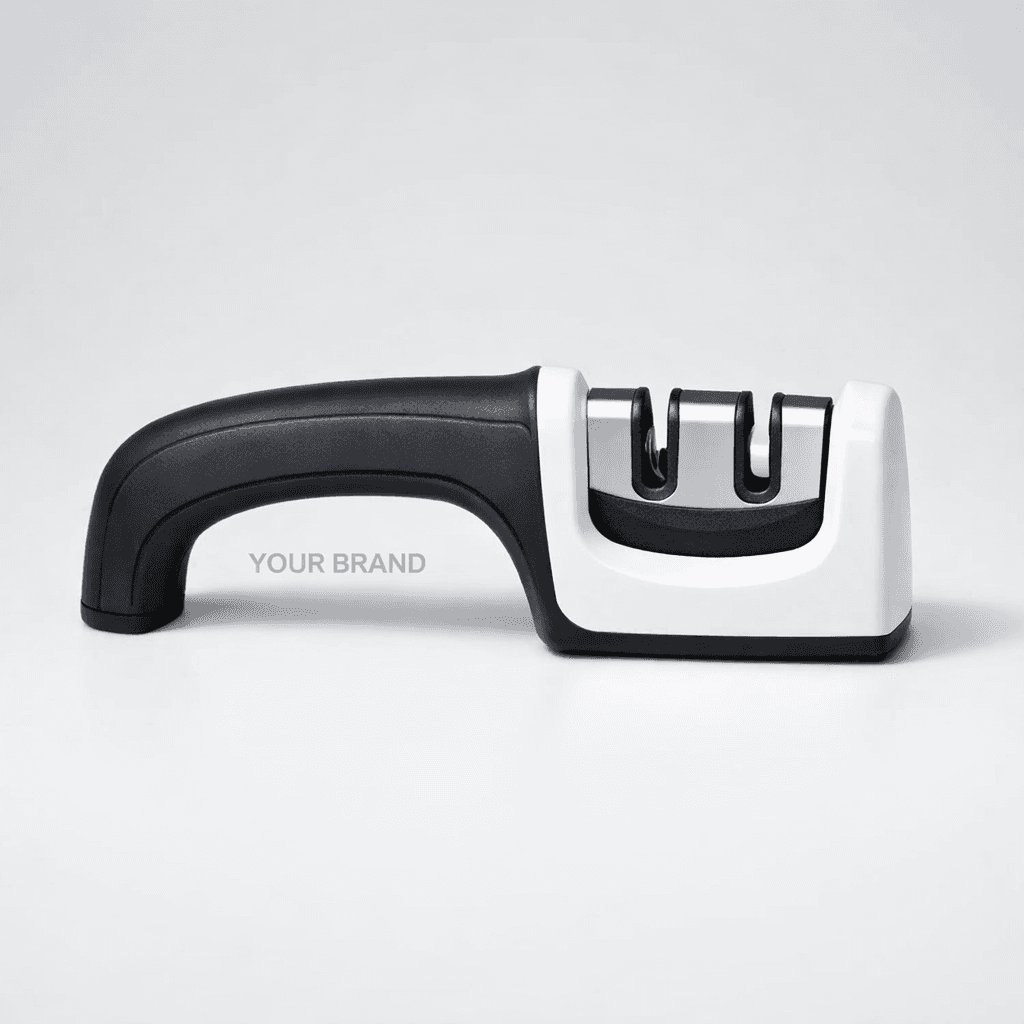
Product opportunity
Is knife sharpener (3-stage) a good private-label product?
A private label three-stage knife sharpener can be a practical kitchen retail product, but the number of slots alone says little about how well it will work. Each stage needs a defined purpose, abrasive material, grit or performance range, sharpening angle and blade compatibility. The handle, base and slot guards must also keep the tool stable while a user draws a blade through it. A credible sourcing brief therefore starts with the knives and users the product is meant for, then specifies the sharpening sequence and safety features rather than accepting a supplier's standard coarse, medium and fine labels without supporting detail.
The commercial case
Manual knife sharpeners appeal to households, caterers, food-service operators, kitchenware retailers and gift-set buyers because maintaining an existing knife is cheaper and more convenient than replacing it whenever the edge becomes dull. The product is compact, easy to demonstrate and suitable for bundles with chopping boards or utensils. Its commercial weakness is disappointed performance: an underspecified sharpener may remove too much metal, fail to refine the edge, slip on a worktop or claim compatibility with blades it should not sharpen. A brand earns repeat trust by giving accurate instructions, limiting compatibility claims and keeping abrasive performance consistent across batches.
Market fit
Demand, buyers, and the brand angle
Buyers often compare sharpeners by slot count and appearance, while experienced users care about the abrasive sequence, edge angle, stability and whether the tool suits their knives. Entry products may use a simple carbide and ceramic combination, while higher positions can improve abrasive consistency, ergonomics, base grip, replaceable modules or left- and right-handed usability. Serrated, single-bevel, ceramic and very thin blades may require different care, so broad all-knife claims should be avoided unless the exact construction has been evaluated for those blade types. Clear diagrams and short usage guidance can be a stronger differentiator than decorative packaging.
What drives demand
- Kitchen knives lose useful sharpness through routine household and food-service use, creating an ongoing maintenance need.
- A guided manual sharpener feels more accessible to many buyers than learning to hold a freehand angle on a whetstone.
- Compact kitchen tools work well in demonstrations, gift sets and add-on sales alongside utensils and chopping products.
- Clear stage labels and usage instructions help first-time users understand the difference between reshaping and finishing an edge.
Likely customer groups
- Kitchenware shops, supermarkets and online home-goods sellers
- Households that want simple routine knife maintenance
- Caterers, small restaurants and food-preparation businesses
- Gift-box and branded household-product companies
Recommended white-label angle
Build the brand around controlled, understandable edge maintenance. Label each slot by function, use directional arrows, include a concise guide showing pressure and stroke sequence, and state the blade types that are excluded. A restrained logo on the body, a distinctive grip colour and a well-designed recyclable carton can make the product recognisable without interfering with use. For a premium range, consider replaceable sharpening modules or a coordinated kitchen-care kit, but only after the core tool passes stability, durability and edge-performance comparisons against the approved sample.
Build the brief
Specifications to settle before requesting quotes
Send every shortlisted supplier the same written brief. That makes quotations comparable and reduces substitutions after sample approval.
- Stage sequence
- Define the purpose of every slot—such as edge repair, sharpening and honing—and require the supplier to identify the abrasive used in each stage.
- Abrasive construction
- Record carbide, diamond-coated, ceramic or other inserts, their grade or performance target, mounting method and permitted wear after cycle testing.
- Sharpening angle
- Specify the nominal angle or supported range and confirm that the guide geometry stays consistent on both sides of the slot.
- Blade compatibility
- List suitable blade materials, thicknesses and edge styles, plus clear exclusions for serrated, ceramic, single-bevel or specialist knives where applicable.
- Body and handle
- Set body material, handle length, grip texture, finger clearance, handedness and resistance to cracking under normal pulling force.
- Base stability
- Define the non-slip material and footprint, then test movement on dry and lightly damp representative worktop surfaces.
- Slot guards
- Check that the housing guides the blade without exposing fingers to the edge or allowing contact with unintended plastic surfaces.
- Instructions and packaging
- Approve diagrams, stroke direction, pressure guidance, cleaning warnings, compatibility statements, barcode and retail-carton protection.
Customization ideas
- Moulded or printed logo on a flat body panel away from the grip
- Brand-colour handle insert, base accent or stage identifiers
- Instruction-led retail carton with a simple three-step diagram
- Kitchen maintenance bundle with a suitable chopping board or utensil set
Possible market positions
- 1. A clearly labelled three-step sharpener for everyday household knives
- 2. A stable ergonomic model for busy home and small food-service kitchens
- 3. A premium replaceable-module sharpener supported by honest compatibility guidance
- 4. A kitchen-care gift set paired with complementary preparation accessories
Supplier due diligence
Ask better questions. Inspect the answers.
Questions for potential suppliers
- 1Which abrasive material is fitted in each stage, and what is each slot intended to do to the blade edge?
- 2What sharpening angle does the guide create, and what production tolerance applies to the insert geometry?
- 3Which blade materials and edge types have you evaluated, and which knives should the instructions explicitly exclude?
- 4How do you test abrasive retention, sharpening consistency and wear over repeated cycles?
- 5What base material and stability test do you use to reduce movement during sharpening?
- 6Can you provide production-equivalent samples, edge-performance comparisons and retained reference units for inspection?
Quality-control checklist
- Confirm stage order, abrasive identity, insert alignment and sharpening-guide angle against the approved specification.
- Use consistent test blades to compare edge condition before and after the stated sharpening sequence.
- Repeat cycle tests to look for rapid abrasive wear, loose inserts, widening slots or changes in sharpening performance.
- Inspect handle comfort, finger clearance, body joints, moulding defects, sharp plastic edges and base adhesion.
- Test stability on representative dry and lightly damp worktops using the pressure described in the instructions.
- Verify compatibility warnings, diagrams, cleaning guidance, logo durability, pack count, barcode and carton condition.
Protect the order
Risks to resolve before production
Uncontrolled edge removal
A coarse or poorly aligned insert can remove unnecessary metal or leave an uneven edge. Define the stage purpose and compare performance on consistent test blades.
Misleading compatibility
A tool marketed for every knife may damage or perform poorly on serrated, ceramic, single-bevel or unusually thin blades. Use specific inclusions and exclusions.
Worktop movement
A small footprint, weak grip material or an awkward handle can allow the sharpener to slide during use, increasing frustration and injury risk.
Abrasive substitution
Production inserts can differ from the sample in grade, mounting or alignment unless the materials and inspection reference are fixed in the order.
Shipping and landed-cost planning
Manual knife sharpeners are relatively compact, but dense abrasive inserts and projecting handles can create damage when units are loosely packed. Approve an individual tray, insert or carton that prevents one tool from striking another and protects printed surfaces. Request final unit and master-carton dimensions, gross weight, carton strength and units per carton before comparing landed estimates. Packaging should also keep abrasive dust or factory residue away from the retail presentation. Inspect cartons for crushed handles, loose inserts and base deformation after a representative transport-handling test.
Product sourcing FAQ
Questions founders ask before sourcing
Open any question to read the answer.
What do the three stages of a knife sharpener do?
The intended functions vary by model. A common sequence uses a coarse stage for damaged or very dull edges, a sharpening stage to form the edge and a finer stage to hone or polish it. Confirm the actual abrasives rather than relying on labels.
Can a manual knife sharpener carry a private label?
Yes. Branding options include moulded, printed or laser-marked logos, custom grip colours, labelled sharpening stages, instruction leaflets and retail cartons.
Can one three-stage sharpener be used for every knife?
Not necessarily. Serrated, ceramic, single-bevel and specialist blades can require different methods. The packaging should state tested compatibility and exclusions clearly.
What should be tested on a knife-sharpener sample?
Check insert material and alignment, sharpening angle, edge results on consistent test blades, abrasive wear, handle clearance, base stability, body durability and instruction accuracy.
Why is the non-slip base important?
The user pulls a blade through the tool, so movement can reduce control. Evaluate the base footprint and grip on representative worktops under realistic pressure.
How can a brand keep knife-sharpener quality consistent?
Freeze the abrasive materials, guide geometry, body, base and instructions; retain an approved sample; run repeated-cycle checks; and compare production performance before shipment.