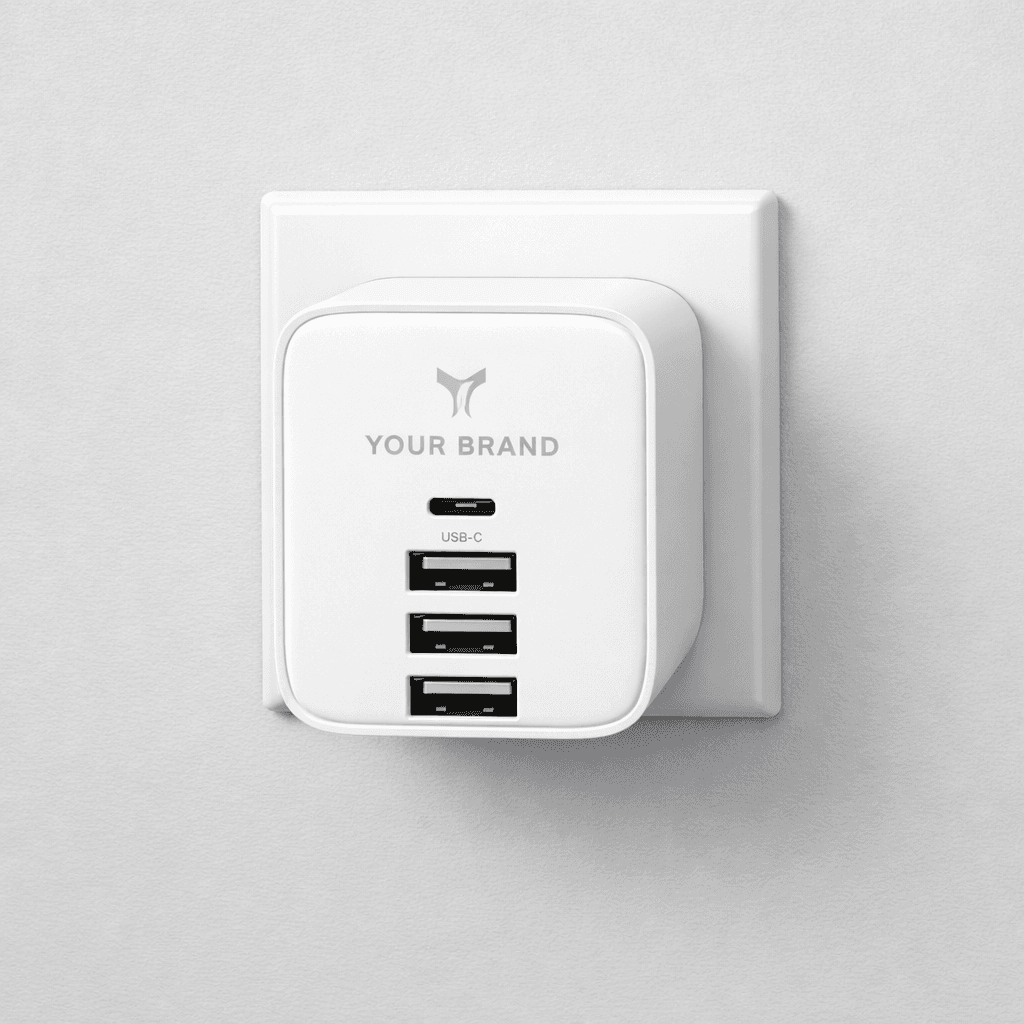
Product opportunity
Is multi-port usb wall charger a good private-label product?
Multi-Port USB Wall Charger can become a credible private-label offer when the product is defined around a real customer use rather than selected from a supplier photograph. A multi-port wall charger solves the common problem of charging several phones and accessories from one outlet, but safe, useful performance depends on honest output allocation, thermal design, insulation and protocol compatibility. Buyers should translate that opportunity into a written specification covering rated input, port configuration, output distribution, charging protocols, packaging and batch consistency. Quotations should only be compared after suppliers confirm the same construction, test methods and branding scope, because a lower price may reflect a materially different product.
The commercial case
Reliable chargers can serve phone-accessory stores, travel brands, offices, schools, hospitality operators and corporate gifting, with USB-C power, compact design and replaceable cables supporting clearer premium tiers. The strongest proposition gives the buyer a clear reason to choose this version and gives the brand enough control to reproduce the same experience on repeat orders. Commercial planning should include the intended sales channel, pack configuration, warranty or complaints policy, inspection cost and realistic landed-cost assumptions. A pre-production sample, approved artwork and measurable acceptance criteria are more valuable than broad claims such as “premium quality.”
Market fit
Demand, buyers, and the brand angle
Buyers look beyond total wattage once they understand that output may be shared across ports. Port mix, charging speed with multiple devices, plug format, heat, size and cable inclusions influence satisfaction more than port count alone. Entry, mid-range and premium offers should be separated through measurable differences in rated input, port configuration, output distribution, charging protocols, electrical protection rather than through packaging language alone. Before committing to inventory, test the proposed product and price with the intended customer segment, compare competing pack sizes and identify the complaints that appear repeatedly in the category. Those findings should shape the supplier brief and the claims used on the final listing.
What drives demand
- Households and offices often charge several devices from limited outlets.
- USB-C adoption creates demand for updated charging equipment.
- Travel and hospitality users value compact shared charging points.
- Phone-accessory replacement and gifting create recurring retail demand.
Likely customer groups
- Phone and computer accessory retailers
- Offices, schools, hotels and short-let operators
- Travel-accessory and corporate-gifting companies
- Online electronics and mobile-lifestyle brands
Recommended white-label angle
Position the charger around a defined device mix and publish a readable power-distribution table. Keep model number, rated input/output and safety markings consistent across product, packaging and documentation, and never reuse reports from a different internal design. Practical customization options include Controlled enclosure colour with laser or pad-printed logo; USB-C-led, mixed-port or travel-focused configuration; Bundle with specified, tested charging cables; Compact retail box with power-allocation diagram and device guidance. Keep the brand promise tied to features that can be inspected and repeated. Approve physical colour references, logo placement, packaging artwork, instructions and barcode data together with the product sample, then prohibit material or component substitutions without written approval. This creates a defensible range instead of a generic item carrying a new logo.
Build the brief
Specifications to settle before requesting quotes
Send every shortlisted supplier the same written brief. That makes quotations comparable and reduces substitutions after sample approval.
- Rated input
- Define voltage and frequency range, destination plug, earth arrangement where applicable and input current.
- Port configuration
- List USB-C and USB-A ports, connector durability, spacing and whether cables can be inserted simultaneously.
- Output distribution
- State voltage, current and wattage by port alone and in every relevant multi-port combination.
- Charging protocols
- Specify supported protocols per port and verify negotiation with representative target devices and cables.
- Electrical protection
- Require controls for over-current, over-voltage, short circuit, abnormal temperature and other defined fault conditions.
- Insulation and construction
- Control creepage, clearance, transformer, PCB, enclosure material, assembly and production electrical tests.
- Thermal performance
- Set temperature-rise limits and test sustained rated loads, shared loads and elevated ambient conditions.
- Markings and packaging
- Approve durable ratings, model, traceability, instructions, warnings, barcode and evidence for the destination market.
Customization ideas
- Controlled enclosure colour with laser or pad-printed logo
- USB-C-led, mixed-port or travel-focused configuration
- Bundle with specified, tested charging cables
- Compact retail box with power-allocation diagram and device guidance
Possible market positions
- 1. One dependable charging point for family devices
- 2. USB-C desk and travel charger for mobile professionals
- 3. Managed multi-device charging for hospitality rooms
- 4. Branded technology gift supported by clear output information
Supplier due diligence
Ask better questions. Inspect the answers.
Questions for potential suppliers
- 1How do you define, measure and control rated input for this exact model, and what evidence can you provide from production batches?
- 2How do you define, measure and control port configuration for this exact model, and what evidence can you provide from production batches?
- 3How do you define, measure and control output distribution for this exact model, and what evidence can you provide from production batches?
- 4How do you define, measure and control charging protocols for this exact model, and what evidence can you provide from production batches?
- 5How do you define, measure and control electrical protection for this exact model, and what evidence can you provide from production batches?
- 6How do you define, measure and control insulation and construction for this exact model, and what evidence can you provide from production batches?
Quality-control checklist
- Inspect and test rated input against the approved sample, written tolerance and agreed acceptance method on units selected across the batch.
- Inspect and test port configuration against the approved sample, written tolerance and agreed acceptance method on units selected across the batch.
- Inspect and test output distribution against the approved sample, written tolerance and agreed acceptance method on units selected across the batch.
- Inspect and test charging protocols against the approved sample, written tolerance and agreed acceptance method on units selected across the batch.
- Inspect and test electrical protection against the approved sample, written tolerance and agreed acceptance method on units selected across the batch.
- Inspect and test insulation and construction against the approved sample, written tolerance and agreed acceptance method on units selected across the batch.
Protect the order
Risks to resolve before production
Misleading total output
Headline wattage may not remain available when several ports operate together.
Overheating
Weak conversion design, small enclosures and poor components can create excessive temperature under sustained load.
Internal substitutions
A supplier can change PCB, transformer or protection components while retaining the same outer casing.
Wrong market version
Plug, voltage marking, documentation and applicable evidence must match the actual destination and model.
Shipping and landed-cost planning
Wall chargers are dense and can damage one another when loose inside cartons. Protect plug pins, finishes and retail boxes, keep models and destination plug versions segregated, and do not include a lithium item in a bundle without confirming its separate shipping requirements. Obtain the final individual pack size, master-carton dimensions, units per carton, gross weight and stacking arrangement from a production-equivalent branded sample before confirming freight. Packaging should protect the product through compression, vibration, moisture and handling appropriate to the route. Recheck carton markings, batch traceability, quantities and product condition before release, and calculate landed cost from the approved packed configuration rather than an early supplier estimate.
Product sourcing FAQ
Questions founders ask before sourcing
Open any question to read the answer.
Can multi-port usb wall charger be private labelled?
Yes. The product can be differentiated through controlled colours, construction, branding and packaging. Approve the complete branded sample and record the specification before mass production rather than treating logo application as the only private-label decision.
What specifications matter when sourcing multi-port usb wall charger?
The core specification should cover rated input, port configuration, output distribution, charging protocols, electrical protection, insulation and construction, plus branding, pack configuration, tolerances, inspection method and batch traceability. The exact priorities should follow the intended customer and use case.
How should suppliers for multi-port usb wall charger be compared?
Send every shortlisted supplier the same written brief and ask for a production-equivalent sample. Compare confirmed construction, test evidence, quality controls, packaging capability, change-control process and response to defects—not the headline quotation alone.
What should be checked before approving a production sample?
Check dimensions, materials, functional performance, workmanship, colour, odour where relevant, logo durability, packaging, instructions and the claims printed on the pack. Retain the signed sample as the inspection reference.
What are the main sourcing risks for multi-port usb wall charger?
Important risks include misleading total output, overheating, internal substitutions, wrong market version. Convert each risk into a specification, supplier question or inspection checkpoint before the purchase order is placed.
How should multi-port usb wall charger be prepared for shipping?
Wall chargers are dense and can damage one another when loose inside cartons. Protect plug pins, finishes and retail boxes, keep models and destination plug versions segregated, and do not include a lithium item in a bundle without confirming its separate shipping requirements. Confirm the final packed dimensions and test the shipping configuration before using it for freight and landed-cost calculations.