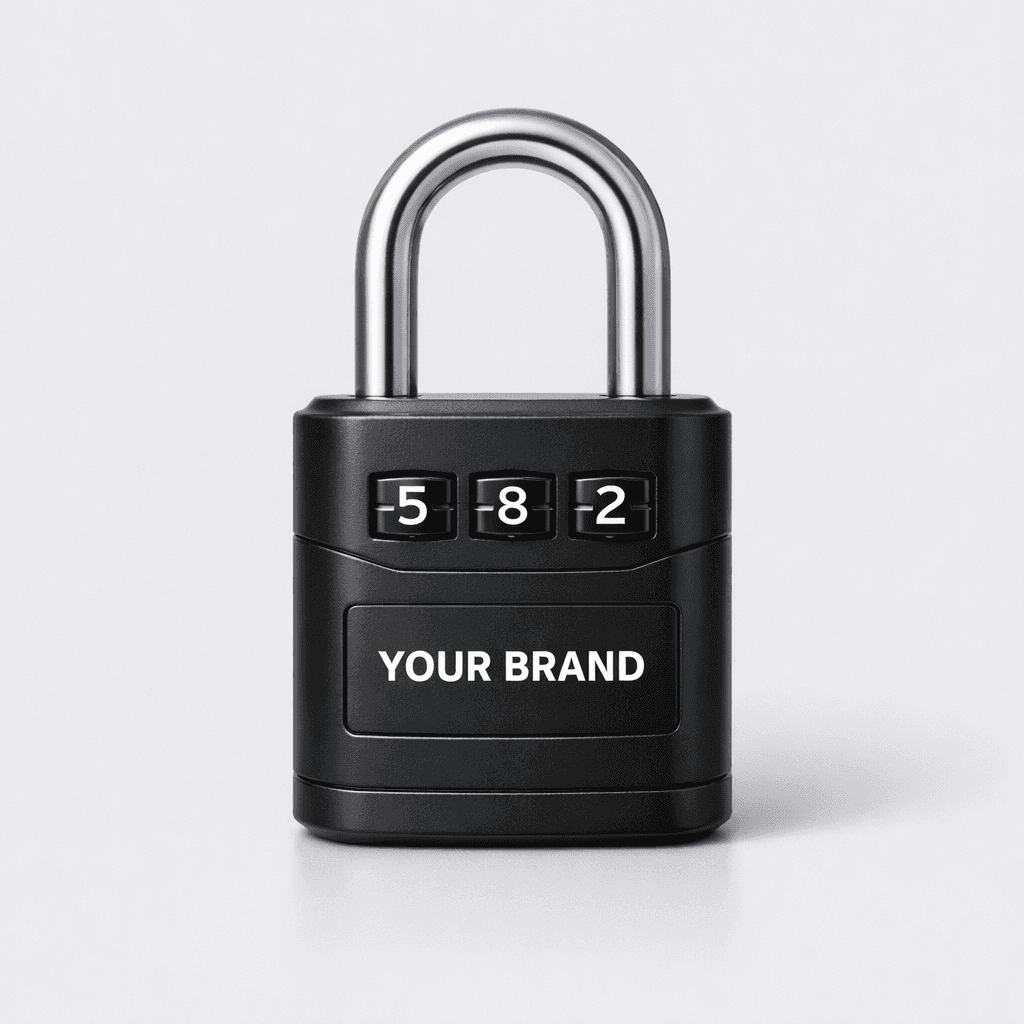
Product opportunity
Is portable combination padlock a good private-label product?
Portable Combination Padlock should be sourced around a clear buying brief: reliable code setting and fit for the intended luggage or locker. Choose the shackle geometry and intended use before comparing dial counts. A compact travel lock and a heavier locker lock face different loads and attachment clearances. Send suppliers the same intended use, dimensions, performance expectations and destination market so quotations describe comparable goods. Approve the complete branded sample before committing to production.
The commercial case
For an importer, the commercial question is whether portable combination padlock can meet a defined customer need at a workable landed cost. Potential buyers include luggage retailers, travel-accessory brands, sports locker suppliers, gift agencies. Customers need readable numbers, positive dial movement and a reset procedure they can follow without accidentally locking themselves out. Compare the finished saleable pack, not just the loose factory item: include packaging, inspection, freight, import charges and a realistic allowance for damaged or returned goods. Confirm the minimum order separately for stock goods, custom colours and custom packaging.
Market fit
Demand, buyers, and the brand angle
Customers need readable numbers, positive dial movement and a reset procedure they can follow without accidentally locking themselves out. Test the lock on representative zipper pulls or hasps. Avoid theft-proof claims or travel-security logos without the relevant authorisation. Use samples and buyer feedback to choose the first specification; interest in a category does not guarantee sales for every size, colour or construction.
What drives demand
- A practical customer need: reliable code setting and fit for the intended luggage or locker.
- An identifiable retail route through luggage retailers and travel-accessory brands.
- A clear assortment opportunity: high-contrast number dials paired with flexible cable or rigid shackle.
- Demonstrable differences in shackle fit and dial mechanism give buyers concrete features to compare.
Likely customer groups
- Luggage retailers
- Travel-accessory brands
- Sports locker suppliers
- Gift agencies
Recommended white-label angle
Build the branded offer around reliable code setting and fit for the intended luggage or locker. Options include high-contrast number dials; flexible cable or rigid shackle; compact carry format; printed code-reset guide. Ask which options use existing tooling and which require a new mould, material purchase or packaging run. The approval sample should combine final construction, artwork and instructions, with written change control for repeat orders.
Build the brief
Specifications to settle before requesting quotes
Send every shortlisted supplier the same written brief. That makes quotations comparable and reduces substitutions after sample approval.
- Shackle fit
- Specify opening width, clearance, diameter and intended attachment types.
- Dial mechanism
- Assess number alignment, positive indexing and repeated locking cycles.
- Reset control
- Verify the exact reset sequence and safeguards against unintended changes.
- Housing durability
- Identify materials and assess corrosion, impact and pull resistance for the intended claim.
- Saleable pack and assortment
- Define whether the quotation covers one item, a pair or a set; list included components, colour ratios, inner-pack counts and dimensional tolerances.
- Branding and instructions
- Approve the exact logo method on portable combination padlock, artwork position, rub resistance, barcode and product-specific care instructions before the packaging run.
- Batch control
- Require production-lot identification, recorded material or component changes and a retained finished sample that can be compared with repeat deliveries.
Customization ideas
- High-contrast number dials
- Flexible cable or rigid shackle
- Compact carry format
- Printed code-reset guide
Possible market positions
- 1. Lead with reliable code setting and fit for the intended luggage or locker and show the feature in use.
- 2. Develop a focused pack for luggage retailers before expanding the assortment.
- 3. Offer high-contrast number dials as a visible differentiator, supported by the approved sample.
- 4. Use instructions that explain shackle fit and housing durability in language the end customer understands.
Supplier due diligence
Ask better questions. Inspect the answers.
Questions for potential suppliers
- 1For shackle fit, what specification and test evidence can you provide? Specify opening width, clearance, diameter and intended attachment types.
- 2For dial mechanism, what specification and test evidence can you provide? Assess number alignment, positive indexing and repeated locking cycles.
- 3For reset control, what specification and test evidence can you provide? Verify the exact reset sequence and safeguards against unintended changes.
- 4For housing durability, what specification and test evidence can you provide? Identify materials and assess corrosion, impact and pull resistance for the intended claim.
- 5Which of these options can you make using existing tooling: high-contrast number dials or flexible cable or rigid shackle? Quote the minimum order and setup cost for each separately.
- 6Can you supply the final branded and packed portable combination padlock for approval, retain a matching reference, and obtain written consent before changing its materials or construction?
Quality-control checklist
- Check shackle fit on production samples against the agreed method and acceptance limits. Specify opening width, clearance, diameter and intended attachment types.
- Check dial mechanism on production samples against the agreed method and acceptance limits. Assess number alignment, positive indexing and repeated locking cycles.
- Check reset control on production samples against the agreed method and acceptance limits. Verify the exact reset sequence and safeguards against unintended changes.
- Check housing durability on production samples against the agreed method and acceptance limits. Identify materials and assess corrosion, impact and pull resistance for the intended claim.
- Review reset confusion and dial misalignment after the intended handling or use test, not only on an untouched display sample.
- Verify final logo, instructions, model or size labels, pack count and lot identification; inspect units from several cartons against the retained approved sample.
Protect the order
Risks to resolve before production
Reset confusion
Poor instructions can leave users unable to reopen a new lock.
Dial misalignment
Numbers that sit between positions make operation unreliable.
Attachment mismatch
A thick shackle may not fit luggage zipper pulls.
Unsupported security claims
Do not claim resistance or approved travel status without evidence.
Shipping and landed-cost planning
Ship in a clearly documented initial configuration and protect dials from abrasion. Sample opening, resetting and relocking after packing tests. Verify instructions describe the exact model rather than a visually similar lock. Obtain measured packed dimensions, carton quantities and gross weight before comparing air and sea freight. Include the agreed packing arrangement in the purchase specification and inspect it before dispatch.
Product sourcing FAQ
Questions founders ask before sourcing
Open any question to read the answer.
Can I print a travel-security approval logo on any lock?
No. Verify the manufacturer's authorisation and the exact product's eligibility before using a protected logo or approval claim. A generic combination mechanism is not evidence of that status.
What should I specify when importing portable combination padlock?
Start with shackle fit, dial mechanism, reset control, housing durability. Add the saleable pack, branding, intended customer and destination market. Ask suppliers to confirm each item in writing rather than substituting a stock catalogue description.
Can portable combination padlock carry my own brand?
Ask about high-contrast number dials, flexible cable or rigid shackle, compact carry format, printed code-reset guide. Branding feasibility and order quantities depend on the construction and factory. Approve the actual finish and packaging together, including any setup charges.
How should I compare factory quotations?
Give each supplier the same portable combination padlock specification. Separate unit price, tooling, artwork, packaging, sample charges and inspection. Confirm the named delivery term and what transport is included; a low factory price alone does not establish a better landed cost.
Which samples should I check before ordering?
Evaluate a functional sample against shackle fit and dial mechanism, then approve a final branded pre-production sample. Resolve reset confusion before releasing the order and retain a reference for shipment inspection.
How do I start sourcing portable combination padlock through LineScout?
Use the sourcing action on this product page and include your target quantity, destination, required specification and branding preferences. Ask for sample and freight options before confirming the production order.