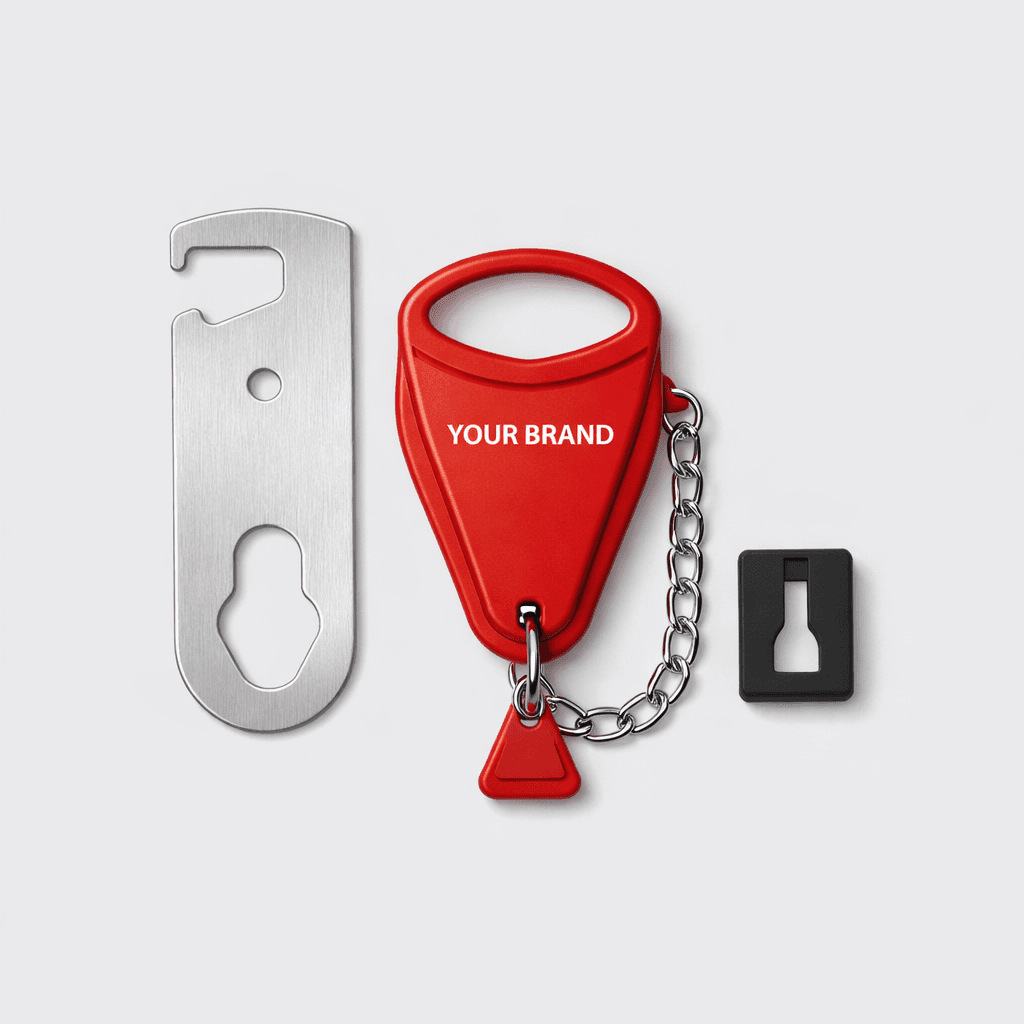
Product opportunity
Is portable door lock (security) a good private-label product?
Portable Travel Door Lock should be sourced around a clear buying brief: compatible latch geometry and quick release from inside. Identify the door and strike-plate arrangements the product supports. A portable add-on lock is not a universal security device and should not prevent the user from exiting promptly. Send suppliers the same intended use, dimensions, performance expectations and destination market so quotations describe comparable goods. Approve the complete branded sample before committing to production.
The commercial case
For an importer, the commercial question is whether portable travel door lock can meet a defined customer need at a workable landed cost. Potential buyers include travel-accessory retailers, personal-security shops, luggage brands, online travel stores. Travellers need a clear fit check before relying on the device. Compare the finished saleable pack, not just the loose factory item: include packaging, inspection, freight, import charges and a realistic allowance for damaged or returned goods. Confirm the minimum order separately for stock goods, custom colours and custom packaging.
Market fit
Demand, buyers, and the brand angle
Travellers need a clear fit check before relying on the device. Test installation with representative inward-opening doors and explain exclusions. Compare practical release and storage with the supplier's dramatic strength demonstration, which may not reflect real door construction. Use samples and buyer feedback to choose the first specification; interest in a category does not guarantee sales for every size, colour or construction.
What drives demand
- A practical customer need: compatible latch geometry and quick release from inside.
- An identifiable retail route through travel-accessory retailers and personal-security shops.
- A clear assortment opportunity: compact carry pouch paired with high-contrast release part.
- Demonstrable differences in latch fit and structural parts give buyers concrete features to compare.
Likely customer groups
- Travel-accessory retailers
- Personal-security shops
- Luggage brands
- Online travel stores
Recommended white-label angle
Build the branded offer around compatible latch geometry and quick release from inside. Options include compact carry pouch; high-contrast release part; illustrated fit gauge; rounded contact edges. Ask which options use existing tooling and which require a new mould, material purchase or packaging run. The approval sample should combine final construction, artwork and instructions, with written change control for repeat orders.
Build the brief
Specifications to settle before requesting quotes
Send every shortlisted supplier the same written brief. That makes quotations comparable and reduces substitutions after sample approval.
- Latch fit
- Specify plate thickness, opening geometry and supported door clearance.
- Structural parts
- Identify metal grade, formed dimensions and load-test configuration.
- Release action
- Evaluate removal from inside under normal use and foreseeable loading.
- Contact protection
- Check edges, coatings and potential marking of the door or frame.
- Saleable pack and assortment
- Define whether the quotation covers one item, a pair or a set; list included components, colour ratios, inner-pack counts and dimensional tolerances.
- Branding and instructions
- Approve the exact logo method on portable travel door lock, artwork position, rub resistance, barcode and product-specific care instructions before the packaging run.
- Batch control
- Require production-lot identification, recorded material or component changes and a retained finished sample that can be compared with repeat deliveries.
Customization ideas
- Compact carry pouch
- High-contrast release part
- Illustrated fit gauge
- Rounded contact edges
Possible market positions
- 1. Lead with compatible latch geometry and quick release from inside and show the feature in use.
- 2. Develop a focused pack for travel-accessory retailers before expanding the assortment.
- 3. Offer compact carry pouch as a visible differentiator, supported by the approved sample.
- 4. Use instructions that explain latch fit and contact protection in language the end customer understands.
Supplier due diligence
Ask better questions. Inspect the answers.
Questions for potential suppliers
- 1For latch fit, what specification and test evidence can you provide? Specify plate thickness, opening geometry and supported door clearance.
- 2For structural parts, what specification and test evidence can you provide? Identify metal grade, formed dimensions and load-test configuration.
- 3For release action, what specification and test evidence can you provide? Evaluate removal from inside under normal use and foreseeable loading.
- 4For contact protection, what specification and test evidence can you provide? Check edges, coatings and potential marking of the door or frame.
- 5Which of these options can you make using existing tooling: compact carry pouch or high-contrast release part? Quote the minimum order and setup cost for each separately.
- 6Can you supply the final branded and packed portable travel door lock for approval, retain a matching reference, and obtain written consent before changing its materials or construction?
Quality-control checklist
- Check latch fit on production samples against the agreed method and acceptance limits. Specify plate thickness, opening geometry and supported door clearance.
- Check structural parts on production samples against the agreed method and acceptance limits. Identify metal grade, formed dimensions and load-test configuration.
- Check release action on production samples against the agreed method and acceptance limits. Evaluate removal from inside under normal use and foreseeable loading.
- Check contact protection on production samples against the agreed method and acceptance limits. Check edges, coatings and potential marking of the door or frame.
- Review incompatible doors and difficult escape after the intended handling or use test, not only on an untouched display sample.
- Verify final logo, instructions, model or size labels, pack count and lot identification; inspect units from several cartons against the retained approved sample.
Protect the order
Risks to resolve before production
Incompatible doors
Some doors or latch arrangements will not accept the device.
Difficult escape
A jammed or confusing release can create a serious hazard.
Overstated protection
Do not market the product as a guarantee against forced entry.
Surface damage
Sharp plates or excessive force may mark fittings.
Shipping and landed-cost planning
Protect metal edges and keep release parts together in each kit. Include a clear installation and removal guide with compatibility limits. Verify that packed parts assemble and release correctly after transit. Obtain measured packed dimensions, carton quantities and gross weight before comparing air and sea freight. Include the agreed packing arrangement in the purchase specification and inspect it before dispatch.
Product sourcing FAQ
Questions founders ask before sourcing
Open any question to read the answer.
Can this replace a building's normal door lock?
No. Position it as a compatible supplementary travel accessory, with clear fit and exit requirements. It is not a substitute for appropriate building security or compliance with local fire and access rules.
What should I specify when importing portable travel door lock?
Start with latch fit, structural parts, release action, contact protection. Add the saleable pack, branding, intended customer and destination market. Ask suppliers to confirm each item in writing rather than substituting a stock catalogue description.
Can portable travel door lock carry my own brand?
Ask about compact carry pouch, high-contrast release part, illustrated fit gauge, rounded contact edges. Branding feasibility and order quantities depend on the construction and factory. Approve the actual finish and packaging together, including any setup charges.
How should I compare factory quotations?
Give each supplier the same portable travel door lock specification. Separate unit price, tooling, artwork, packaging, sample charges and inspection. Confirm the named delivery term and what transport is included; a low factory price alone does not establish a better landed cost.
Which samples should I check before ordering?
Evaluate a functional sample against latch fit and structural parts, then approve a final branded pre-production sample. Resolve incompatible doors before releasing the order and retain a reference for shipment inspection.
How do I start sourcing portable travel door lock through LineScout?
Use the sourcing action on this product page and include your target quantity, destination, required specification and branding preferences. Ask for sample and freight options before confirming the production order.