Product opportunity
Is reusable microfiber cleaning cloths a good private-label product?
Reusable microfiber cleaning cloths are inexpensive, easy to bundle and relevant to homes, offices, hospitality, janitorial services and vehicle-care businesses. The product looks simple, but performance changes materially with fibre blend, whether the yarn is properly split, fabric weight, weave, edge construction, dye quality and wash durability. A successful private label range starts with the cleaning job and customer segment, then defines the cloth around that use.
The commercial case
Microfiber cloths can support repeat purchase through multi-packs, colour-coded professional sets and specialised glass, kitchen or automotive variants. Their low unit cost makes sampling and market testing accessible, while packaging and clear use instructions create room for differentiation. The commercial risk is commoditisation: a vague request for a 'good microfiber cloth' usually produces quotations that cannot be compared and batches that feel inconsistent.
Market fit
Demand, buyers, and the brand angle
General household buyers value absorbency, softness, quick drying and easy washing. Cleaning companies may prioritise colour coding, consistent size and durable edges, while car-detailing buyers care about lint, softness and scratch-sensitive finishes. Build separate specifications for each use instead of selling the same cloth as ideal for every surface.
What drives demand
- Cleaning is a recurring household and commercial need rather than a seasonal purchase.
- Reusable cloths can replace repeated purchases of disposable wipes or paper products for many routine tasks.
- Colour-coded sets help professional and household users organise cloths by cleaning zone.
- Low unit weight and flexible pack sizes make the product suitable for retail bundles and add-on sales.
Likely customer groups
- Households and home-organisation shoppers
- Cleaning companies, offices, hotels and short-let operators
- Car-wash and automotive-detailing businesses
- Supermarkets, household retailers and online cleaning brands
Recommended white-label angle
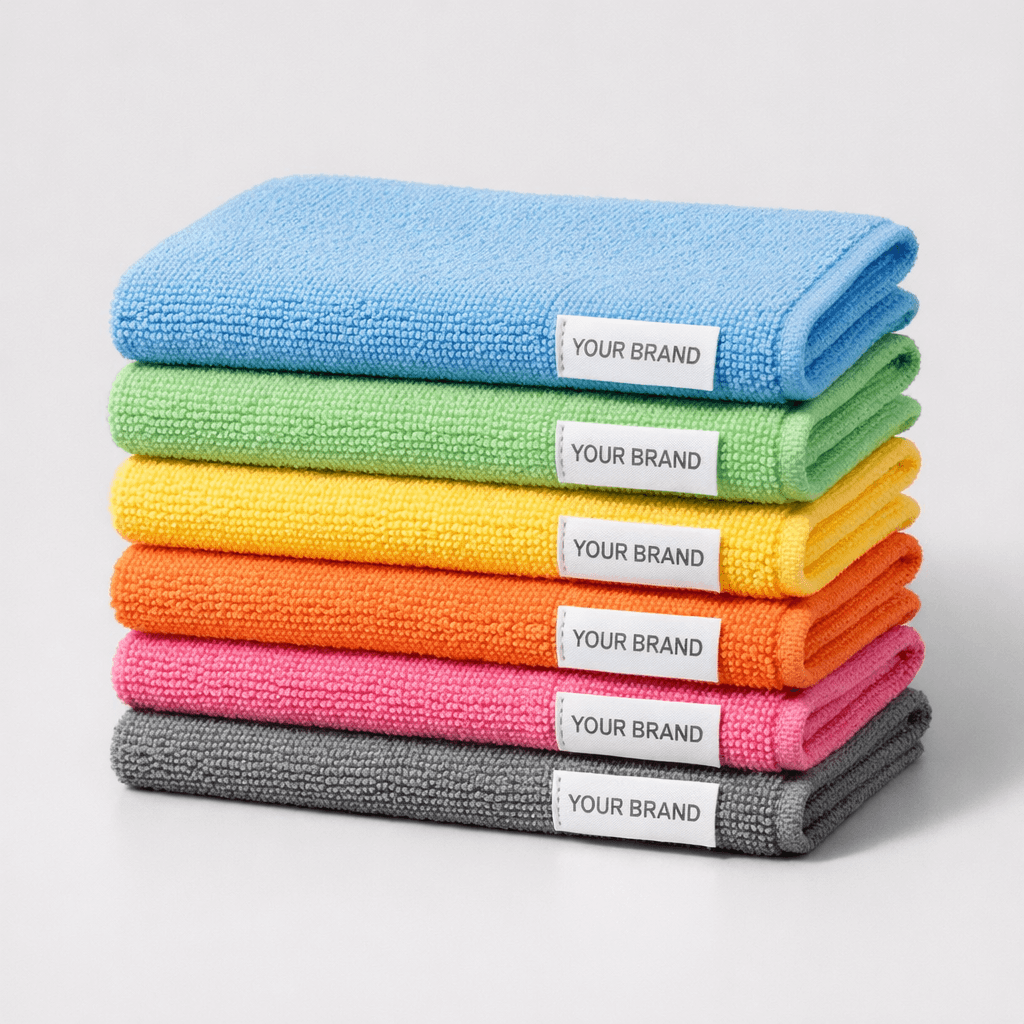
Launch a clearly named cleaning system rather than a loose stack of cloths. Use colours to separate kitchen, bathroom, glass and general-surface tasks; add a woven label or subtle corner print; and package the set with washing instructions. Bundles can be designed for households, professional cleaners, hospitality teams or automotive detailing.
Build the brief
Specifications to settle before requesting quotes
Send every shortlisted supplier the same written brief. That makes quotations comparable and reduces substitutions after sample approval.
- Fibre blend
- Define the polyester/polyamide ratio and require confirmation that the yarn construction suits the intended cleaning task.
- Fabric weight
- State target GSM and tolerance. Compare GSM together with size, weave and finished piece weight.
- Size
- Specify finished length and width plus tolerance after cutting and sewing.
- Weave and pile
- Choose terry, waffle, suede, coral fleece or another construction based on wiping, glass, polishing or drying use.
- Edge finish
- Define overlock, bound, ultrasonic or edgeless finishing and check whether it is safe for the target surface.
- Colour
- Set Pantone references where needed and require colourfastness appropriate for repeated washing.
- Absorbency and lint
- Agree simple test methods and acceptance levels instead of relying on marketing descriptions.
- Pack configuration
- Define cloths per pack, colour mix, folding, label, care instructions and retail packaging.
Customization ideas
- Colour-coded four-pack for kitchen, bathroom, glass and general cleaning
- Woven corner label, embroidery or low-profile printed logo
- Kraft sleeve, reusable pouch or shelf-ready branded box
- Separate household, professional cleaning and car-detailing collections
Possible market positions
- 1. A colour-coded home cleaning system with simple use instructions
- 2. A durable bulk pack for offices, cleaners and hospitality operators
- 3. A low-lint glass and screen cleaning set
- 4. A premium automotive wash, polish and drying collection
Supplier due diligence
Ask better questions. Inspect the answers.
Questions for potential suppliers
- 1What is the exact fibre composition, yarn construction, GSM and allowed tolerance?
- 2How are GSM, finished size, absorbency, lint and colourfastness checked during production?
- 3Which weave and edge finish do you recommend for our stated surface and cleaning use?
- 4Can you wash-test branded samples and show results for shrinkage, bleeding and edge durability?
- 5Will fabric, dye lot and hand feel remain consistent on repeat orders?
- 6What pack sizes and branding methods can be produced without splitting the order into uneconomical colour MOQs?
Quality-control checklist
- Weigh and measure sampled cloths to confirm GSM, finished size and piece-weight consistency.
- Inspect weave, pile, edge stitching, loose fibres, stains, holes and colour variation.
- Run absorbency, lint-transfer and wipe tests on the intended surfaces.
- Wash samples repeatedly to check shrinkage, colour bleeding, distortion and edge failure.
- Rub or wash-test printed and woven branding for durability.
- Confirm pack count, colour assortment, care instructions, barcode and carton quantities.
Protect the order
Risks to resolve before production
GSM without context
A GSM claim alone does not define quality. Size, blend, weave, pile and finished weight must be approved together.
Colour bleeding
Poor dye control can stain other items or fade quickly, especially in mixed-colour sets.
Surface damage or lint
The wrong edge or weave can perform poorly on glass, screens or vehicle finishes despite being sold as multipurpose.
Inconsistent repeat orders
Suppliers may change yarn, dye or finishing unless the approved construction and tolerances are recorded.
Shipping and landed-cost planning
Microfiber cloths are light but can become volumetric cargo when packed in retail boxes or loosely loaded cartons. Ask for final pack and master-carton dimensions before approving the landed-cost estimate. Compression can reduce volume, but excessive compression may damage presentation and increase labour when goods are received. Protect cartons from moisture and specify inner packing for long sea shipments.
Product sourcing FAQ
Questions founders ask before sourcing
Open any question to read the answer.
What GSM is suitable for microfiber cleaning cloths?
The right GSM depends on the use. Lightweight cloths may suit dusting or promotional packs, medium weights often suit general cleaning, and heavier constructions may suit drying or detailing. Blend, weave, size and edge finish matter alongside GSM.
What is the difference between 80/20 and 70/30 microfiber?
The figures normally describe the polyester/polyamide blend. A higher polyamide share can create a softer, more absorbent cloth, but yarn quality, splitting, weave and finishing also affect performance.
Can microfiber cloths carry a private label?
Yes. Options include woven labels, embroidery, printing, custom colours, branded sleeves, pouches and retail boxes. Branding should be tested so it does not create a hard edge on delicate surfaces.
How should I test a microfiber cloth sample?
Check finished size and weight, absorbency, lint, colour transfer, edge durability, cleaning performance on the intended surface and changes after repeated washing.
Should one microfiber cloth be marketed for every cleaning job?
Usually not. Glass, general household cleaning, commercial use and automotive detailing can require different weaves, weights and edges. A segmented range is more credible and easier for customers to understand.
What information should be in a microfiber cloth purchase specification?
Include fibre blend, GSM and tolerance, size, weave, pile, edge, colour, performance tests, logo method, pack configuration, care label, inspection standard and approved sample reference.