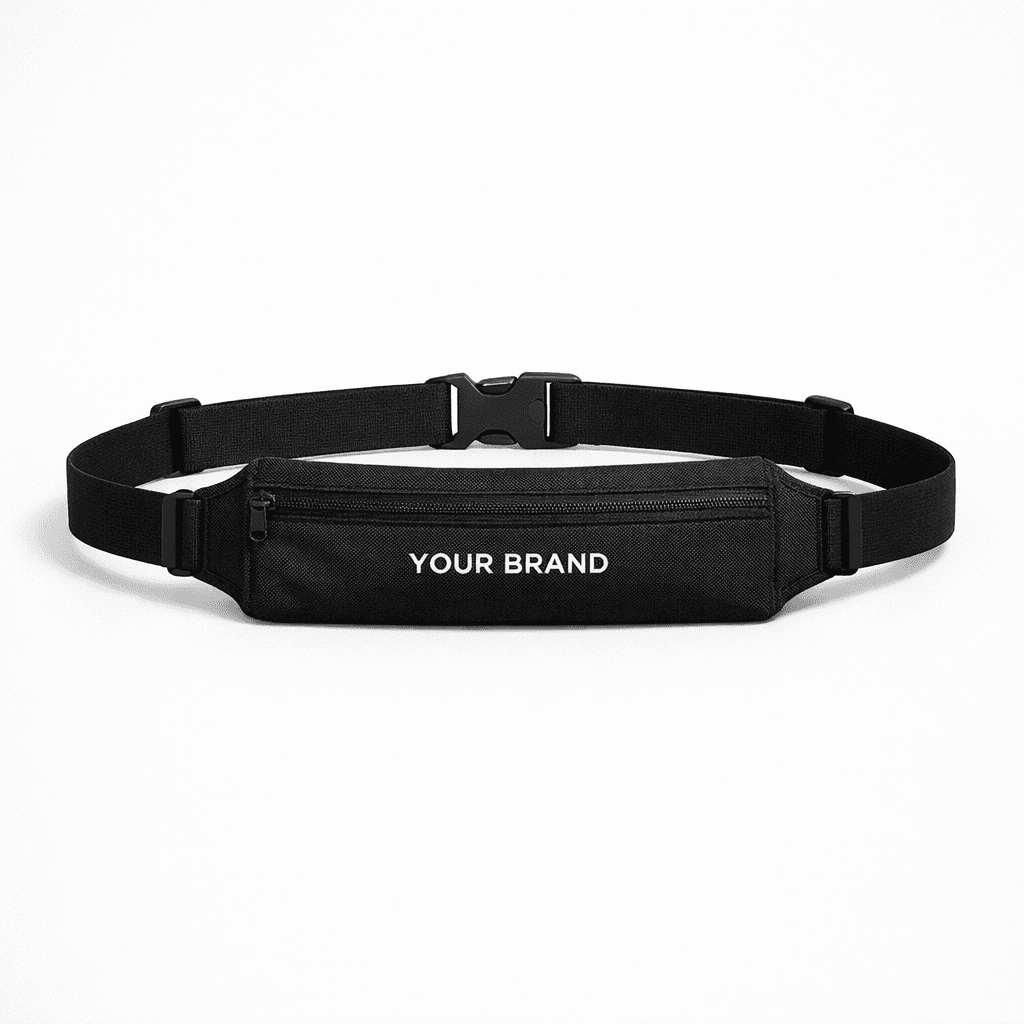
Product opportunity
Is running waist belt a good private-label product?
A private label running waist belt should hold everyday essentials securely without distracting the wearer. That requires more than an elastic strap and a phone-sized pocket. Buyers should specify the intended activities, supported waist range, usable pocket dimensions, representative phone sizes with and without cases, expansion, zipper construction, buckle, strap recovery, seams, skin-contact materials and wash care. Bounce, chafing, sweat exposure and device access must be evaluated on the complete loaded product. Terms such as universal fit, waterproof or reflective should not be printed until they are defined and supported by the exact design and materials.
The commercial case
Running belts fit sports retailers, gyms, wellness brands, race organisers, corporate fitness programmes and ecommerce accessory stores. They serve runners, walkers and travellers who want hands-free storage for a phone, keys, cards or cash. The category is easy to customise but also easy to commoditise, so differentiation should come from dependable fit, honest capacity, low-bulk construction and details that remain comfortable in motion. Brands can offer a core belt, colour variants or event editions, but should resist adding openings and compartments that weaken sweat protection or create pressure points. Realistic user trials are especially valuable because bench measurements alone cannot reveal bounce or chafing.
Market fit
Demand, buyers, and the brand angle
Customers compare whether their phone actually fits, how much the belt moves, zipper access, strap comfort, pocket layout and visibility in low light. Phone compatibility should be stated using internal dimensions and tested device examples rather than a vague universal claim. Water-resistant construction may help with light sweat or splashes, but zippers, seams and cable openings can remain entry points; waterproof language requires a clearly supported test and use condition. Reflective-looking print is not necessarily effective retroreflection. If visibility is part of the proposition, define the material and evaluate it appropriately while reminding users that an accessory does not replace safe road behaviour.
What drives demand
- More people use phones for music, navigation and activity tracking while exercising.
- A hands-free belt serves running, walking, cycling support, travel and outdoor events.
- Gyms, races and wellness programmes can use branded belts as practical merchandise.
- Compact sizing makes the product suitable for ecommerce and coordinated fitness collections.
Likely customer groups
- Sports, fitness and outdoor accessory brands
- Gyms, running clubs, races and wellness programmes
- Corporate promotional and employee-fitness buyers
- Ecommerce stores and general sports retailers
Recommended white-label angle
A focused white label design can use a slim silhouette, controlled stretch panel, soft edge binding, dependable buckle and a clean logo treatment. Choose branding that flexes with the fabric without cracking or creating a stiff patch against the body. Decide whether the pocket is intended for a phone only or also for keys and cards; if items share a compartment, assess screen scratching and pressure. Colourways, reflective details and retail packaging can create a coherent running range with headbands, towels or bottles. Freeze fabric, elastic, zipper, buckle and thread suppliers because substitutions can materially alter fit and durability.
Build the brief
Specifications to settle before requesting quotes
Send every shortlisted supplier the same written brief. That makes quotations comparable and reduces substitutions after sample approval.
- Fit range
- Define the usable waist circumference range under realistic strap tension, adjustment overlap and whether the fit changes when the pocket is loaded.
- Pocket capacity
- State usable internal length, height and expansion plus tested phone dimensions with representative cases, not only external pocket size.
- Body fabric
- Specify fibre composition, knit or weave, basis weight, stretch and recovery, hand feel, colourfastness and restricted-substance requirements.
- Strap and buckle
- Control elastic width, elongation, recovery, adjuster slippage, buckle resin, engagement force and repeated-cycle durability.
- Closure
- Specify zipper type, teeth or coil, slider, puller, end stops, opening length and resistance to snagging and unintended opening.
- Seams and comfort
- Define stitch type and density, seam allowance, reinforcement, edge binding and acceptable interior projections at skin-contact zones.
- Moisture performance
- Describe the exact sweat or splash resistance target and test the finished seams, zipper and openings without overstating waterproofness.
- Branding and visibility
- Specify logo method, size, position, flex durability and any reflective material with objective performance and care expectations.
Customization ideas
- Low-profile single-pocket belt with soft stretch fabric
- Separate key sleeve or divider designed to reduce phone scratching
- Documented reflective logo or trim for an evening-running edition
- Race or corporate colourway with flexible heat-transfer branding
Possible market positions
- 1. Measured-fit running belt with honest phone-and-case compatibility guidance
- 2. Low-bounce essentials belt validated through loaded motion trials
- 3. Sweat-conscious fitness belt with clearly limited protection claims
- 4. Branded event belt with documented reflective trim and practical care instructions
Supplier due diligence
Ask better questions. Inspect the answers.
Questions for potential suppliers
- 1What are the usable internal pocket dimensions, expansion and tested phone-and-case examples?
- 2Which factories make the fabric, elastic, zipper and buckle, and how are component substitutions controlled?
- 3What loaded running or repeated-motion method is used to assess bounce, strap slip, chafing and access?
- 4Which evidence supports sweat resistance, splash resistance, colourfastness and any reflective claim on the finished belt?
- 5What seam, zipper, buckle, elastic-recovery and logo-durability limits form the production release standard?
- 6Can you provide size-set and production-equivalent samples using final components, branding and packaging?
- 7How are needles, sharp fragments, stains, mixed components and batch traceability controlled during sewing and packing?
Quality-control checklist
- Measure relaxed and stretched fit range, pocket opening and usable internal dimensions against the specification.
- Load representative phones, keys and cards as intended, then assess bounce, strap slip, access and comfort during motion trials.
- Inspect fabric, seams, edge binding and interior surfaces for holes, skipped stitches, loose threads, rough projections and asymmetry.
- Cycle the zipper, buckle and adjuster, then check engagement, snagging, end stops, puller security and strap recovery.
- Evaluate colour transfer, sweat exposure, washing and drying according to the supported care instructions.
- Check printed or applied branding for position, adhesion, stretch cracking, abrasion and discomfort against the body.
- Verify any moisture or reflective claim against the agreed method, then confirm labels, care, warnings, origin and batch code.
Protect the order
Risks to resolve before production
Phone does not fit
External measurements and model names can mislead, particularly with cases. Control usable dimensions and test representative devices.
Bounce or strap slippage
Elastic recovery, load distribution, adjuster grip and fit all matter. Conduct loaded motion trials on the final construction.
Overstated water protection
Coated fabric does not make seams, zippers and openings waterproof. Use precise, evidence-based language for limited moisture resistance.
Reflective appearance without performance
Silver or bright print may not provide meaningful retroreflection. Specify a documented material and relevant evaluation if making a claim.
Component substitution
A cheaper zipper, buckle or elastic can change the whole user experience. Name critical components and require change approval.
Shipping and landed-cost planning
Running belts are light and compressible, but tight folding can crease reflective transfers, deform foam or leave permanent pressure marks on zippers and buckles. Agree the folding method, individual packaging, units per carton, carton dimensions, gross weight and stacking limits using final packed samples. Keep buckles positioned so they do not press into neighbouring fabric or scratch printed branding. Protect cartons from moisture, crushing and prolonged heat that may affect elastic and adhesives. After representative transport handling, unfold samples and check elastic recovery, zipper movement, buckle condition, logo cracking, odour and pack presentation before approving dispatch.
Product sourcing FAQ
Questions founders ask before sourcing
Open any question to read the answer.
Can running waist belts be private labelled?
Yes. Brands can customise fabric, dimensions, pocket layout, zipper, strap, colour, logo and packaging, provided the finished combination is sampled and tested.
How do I know which phones fit?
Use the pocket's usable internal dimensions and test real devices with representative cases. Avoid relying only on a phone model list or the word universal.
Can a running belt be called waterproof?
Only when the exact finished construction and intended conditions support that claim. Coated fabric alone does not account for seams, zipper and openings.
How can bounce be reduced?
A close adjustable fit, controlled elastic, balanced pocket and appropriate load help. Validate the design through loaded movement trials with different users.
What is the best logo method?
It depends on the fabric and stretch. Test embroidery, woven labels or flexible transfers for abrasion, cracking, wash durability and comfort before choosing.
What should be inspected before shipment?
Check dimensions and fit, loaded motion, fabric and seams, zipper, buckle, elastic recovery, branding, supported claims, care labels and packaging.