Product opportunity
Is travel neck pillow a good private-label product?
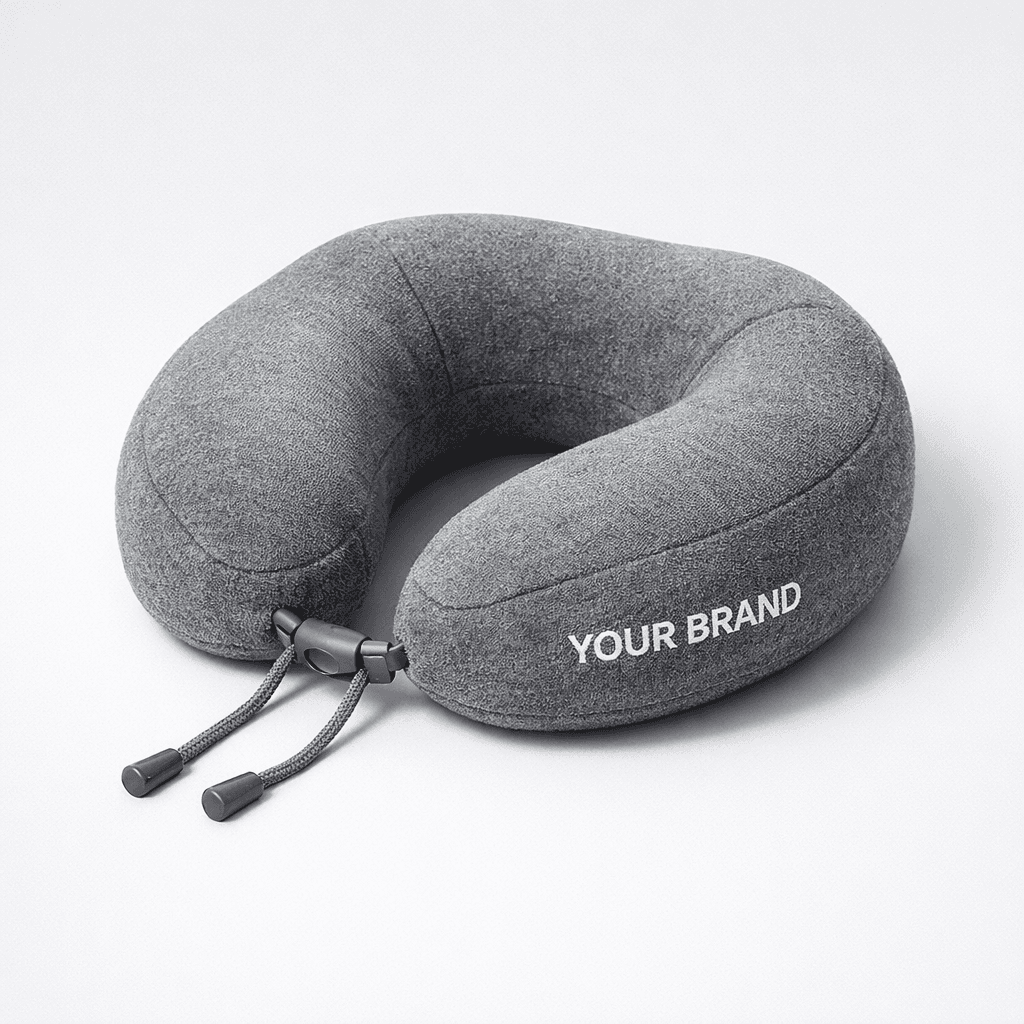
A private label travel neck pillow can serve airline passengers, road travellers, commuters and corporate travel programmes, but the familiar U-shape does not make every model equally supportive. Comfort depends on the foam or fibre filling, finished dimensions, neck opening, contour, firmness, cover fabric, seam placement and how the pillow behaves after compression. A useful sourcing brief must define the intended sleeping position and journey type before suppliers quote, because a soft promotional pillow, a supportive memory-foam model and a compact inflatable pillow solve different customer problems and should not be compared as if they were identical.
The commercial case
Travel neck pillows suit luggage shops, travel-accessory brands, pharmacies, airport retailers, transport companies, hotels and corporate gift programmes. They are visually recognisable, easy to demonstrate and natural to bundle with eye masks, luggage straps, packing cubes or travel pouches. The commercial opportunity is strongest when the product makes a specific comfort promise—such as firmer side support or compact carry—without making medical claims. Returns and weak reviews often come from heat, odour, inadequate support, restrictive openings or pillows that fail to recover after packing, so sample testing and construction control matter more than choosing the lowest quotation.
Market fit
Demand, buyers, and the brand angle
Customers usually judge a neck pillow by comfort, portability, hygiene and appearance. Frequent travellers may accept a larger packed size for better support, while occasional travellers may prefer a lower price or a pillow that clips neatly to luggage. Removable washable covers, breathable face fabrics, secure closures and a useful carrying pouch can improve perceived value. Build entry, mid-range and premium options around measurable differences in filling, contour, cover, packed volume and accessories rather than colours alone, and test the fit with users of different neck and shoulder sizes before finalising one universal claim.
What drives demand
- Long flights, intercity road travel and extended waiting periods create a clear need for portable head and neck support.
- Travellers increasingly value removable, washable covers because pillows are used in shared transport environments.
- Travel accessories bundle naturally, allowing pillows to be paired with eye masks, luggage straps and packing organisers.
- Corporate travel, airline promotions and customer gifts create branded-volume opportunities beyond ordinary retail sales.
Likely customer groups
- Travel-accessory, luggage and airport retailers
- Online comfort, lifestyle and gift brands
- Airlines, tour operators, transport companies and hotels
- Companies preparing travel kits for employees, conferences or customers
Recommended white-label angle
Position the product as a considered travel-comfort system rather than a generic U-shaped cushion. A brand can choose a recognisable cover colour, add restrained embroidery or a woven side label, print clear care instructions and include a pouch that keeps the pillow clean in transit. A coordinated set with an eye mask and earplug case can raise perceived value, while business-travel versions can use neutral colours and discreet branding. Keep comfort language practical and evidence-led: explain the construction and intended use instead of promising to prevent pain or deliver medically proven support.
Build the brief
Specifications to settle before requesting quotes
Send every shortlisted supplier the same written brief. That makes quotations comparable and reduces substitutions after sample approval.
- Pillow construction
- Choose memory foam, fibre fill, microbeads or inflatable construction according to the required support, price, weight and packed size.
- Finished dimensions
- State external length, width, thickness, neck-opening dimensions and tolerances; do not approve a sample using external size alone.
- Support profile
- Define the height and firmness at the back and sides, any chin-support contour and the intended upright sleeping position.
- Foam or filling
- Record material type, density or fill weight, firmness target, recovery behaviour, odour expectations and whether substitutions are prohibited.
- Cover fabric
- Specify fibre composition, knit or weave, softness, breathability, colour, colourfastness and the surfaces that touch the face and neck.
- Removable cover
- Define zip position, zip guard, opening size, washing instructions, shrinkage tolerance and ease of refitting after laundering.
- Closure and carry feature
- Choose snap, buckle, drawcord or magnetic closure and test it both around the neck and when attached to luggage.
- Packing configuration
- Approve the individual pouch, compression method, recovery time, retail insert, barcode position and master-carton dimensions.
Customization ideas
- Embroidered logo or woven side label positioned away from the face
- Pantone-matched removable cover with contrasting piping or closure
- Branded washable carry pouch with a luggage clip
- Travel set combining the pillow with an eye mask and compact accessory pouch
Possible market positions
- 1. Supportive memory-foam pillow for frequent air and road travellers
- 2. Washable travel-comfort set with pillow, eye mask and carry pouch
- 3. Compact luggage-clip pillow for occasional and budget-conscious travellers
- 4. Discreetly branded corporate travel kit for employees and event guests
Supplier due diligence
Ask better questions. Inspect the answers.
Questions for potential suppliers
- 1What filling or foam specification is used, and how do you control density, firmness and recovery between batches?
- 2Can you provide finished neck-opening, side-height and back-height measurements with production tolerances?
- 3How long is the pillow compressed before shipment, and how quickly should it recover after unpacking?
- 4Which cover fabrics and closures have been wash-tested, and what shrinkage or colour-change results were recorded?
- 5Can you prepare unbranded and branded samples using the exact production materials and retain an approved reference sample?
- 6What inspection method do you use for odour, seams, zips, filling consistency, stains, shape and pack count?
Quality-control checklist
- Measure external dimensions, neck opening, side height, back height and finished weight against the approved specification.
- Compare firmness, filling distribution, contour and head-support behaviour with the retained approved sample.
- Inspect seams, zip guards, closures, embroidery, labels and fabric surfaces for rough edges or pressure points.
- Open compression-packed samples from different cartons and record shape recovery, creasing and residual odour.
- Wash removable covers according to the care label and check shrinkage, colourfastness, zip operation and ease of refitting.
- Verify individual pouches, care instructions, barcodes, warning text, carton quantities and moisture protection.
Protect the order
Risks to resolve before production
Inconsistent support
Suppliers can change foam density, filling weight or contour after sample approval. Record the construction and compare production samples with a retained reference.
Compression damage
Aggressive vacuum packing lowers freight volume but may cause permanent creases, slow recovery or distorted foam when the packing method is not tested.
Heat and skin discomfort
A plush appearance can hide a warm, abrasive or poorly placed seam. Evaluate all face-contact surfaces during realistic seated use.
Overstated wellness claims
Comfort products should not be marketed as treating pain or a medical condition without appropriate evidence and destination-market review.
Shipping and landed-cost planning
Memory-foam and fibre-filled neck pillows can occupy substantial carton volume relative to their selling price, so freight planning should begin with the approved packing method rather than an early estimate. Request individual packed dimensions, units per carton, master-carton measurements and gross weight for the final construction. Compression may improve loading efficiency, but production-packed samples should remain compressed for a representative period and then be checked for recovery, odour, creasing and cover distortion. Protect cartons and inner packs from moisture, and confirm that the branded retail presentation still looks acceptable after unpacking.
Product sourcing FAQ
Questions founders ask before sourcing
Open any question to read the answer.
Can travel neck pillows be produced with a private label?
Yes. Common options include embroidered logos, woven labels, custom cover colours, branded closures, care labels, pouches and retail packaging. Keep hard or raised branding away from face-contact areas.
What filling is best for a private label travel pillow?
There is no universal best filling. Memory foam can provide structured support, fibre fill can feel softer, microbeads conform differently, and inflatable designs prioritise compact packing. Choose against the intended customer and journey.
What dimensions should a travel neck pillow specification include?
Record the external dimensions, thickness, neck-opening width and depth, back height, side height and finished weight, together with tolerances and an approved physical sample.
Should a neck-pillow cover be removable?
A removable washable cover can improve hygiene and perceived value. Test the zip position, washing shrinkage, colourfastness and how easily the cover fits again after laundering.
How should compression packing be tested?
Pack production-equivalent samples using the proposed method, keep them compressed for a representative period, then record recovery time, final shape, creasing, odour and any damage to the cover or foam.
How can a travel-pillow brand reduce quality complaints?
Freeze the filling, contour, dimensions, cover, closure and packing method; approve a retained sample; conduct wash and recovery tests; and inspect production units from multiple cartons before shipment.