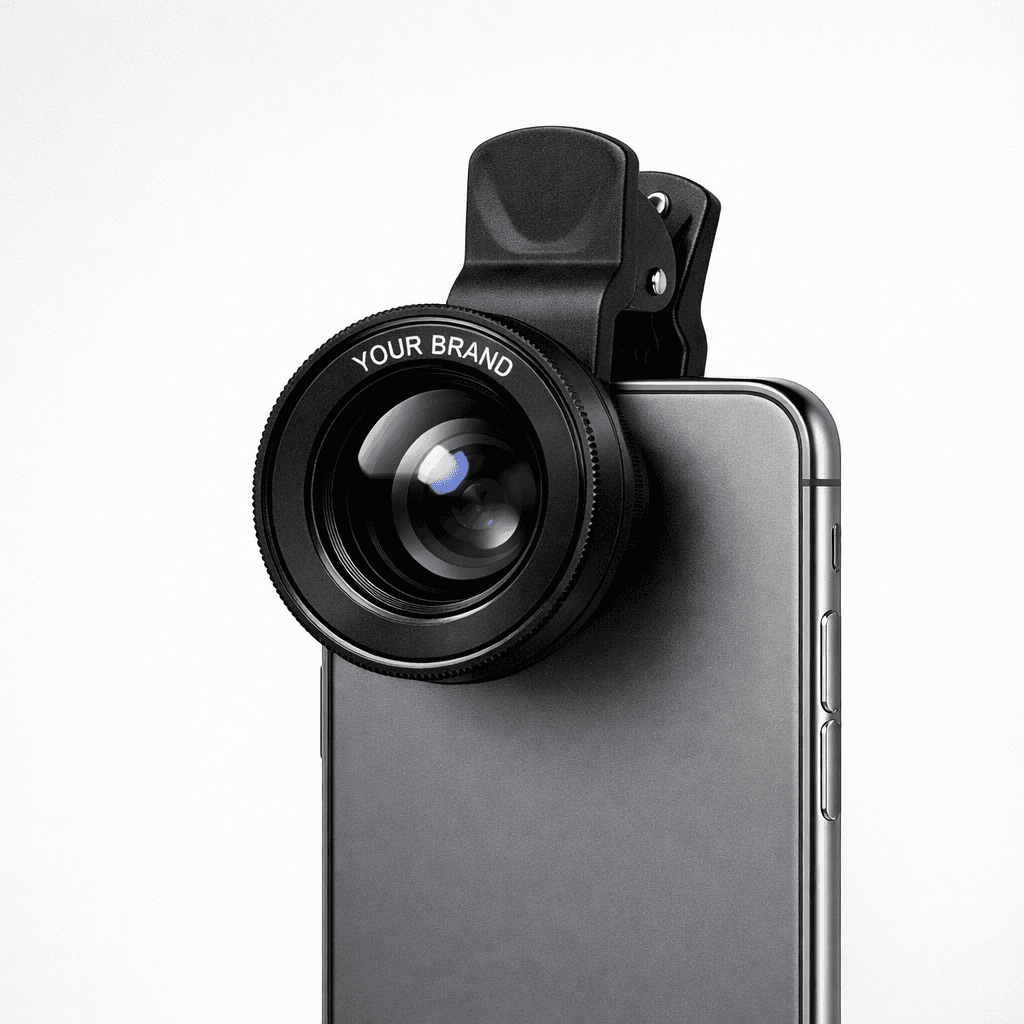
Product opportunity
Is universal phone camera lens clip a good private-label product?
A private label phone camera lens clip is an optical accessory, so the sourcing decision should be based on image results rather than the magnification printed on a carton. Wide-angle, macro and fisheye attachments behave differently, and some kits require lenses to be combined or separated for a particular mode. Performance also changes with phone camera position, sensor choice, case thickness, clip alignment and distance from the built-in lens. Buyers should define the exact lens configuration, optical materials, stated field or magnification method, minimum focus behaviour, distortion and vignetting limits, clip opening, pressure, padding and supported device geometry. Samples should be tested using repeatable scenes and several representative phones before branding.
The commercial case
Clip-on phone lenses appeal to content creators, social sellers, students, travellers, gift buyers and mobile-accessory retailers seeking a compact creative tool. They can demonstrate well in short videos, but customer disappointment rises when promotional images imply professional-camera performance or conceal dark corners, blur and compatibility limitations. A sound product proposition teaches buyers which rear or front camera to use, how to centre the clip, when to remove a phone case and how close a macro lens must be to the subject. Commercial value can come from consistent optics, protective storage, usable instructions and responsive after-sales guidance rather than an inflated lens count.
Market fit
Demand, buyers, and the brand angle
Customers compare included lens types, sharpness, field of view, edge distortion, minimum focus distance, ease of alignment and compatibility with multi-camera phones. The word universal should mean broad compatibility within stated physical limits, not a guarantee for every phone, case and camera mode. Modern devices may automatically switch sensors, use large camera islands or apply computational processing that changes the result. Marketing samples should identify the phone, camera, lens configuration and whether images are cropped or edited. Avoid unsupported specifications, fabricated before-and-after images and claims that the accessory replaces dedicated photographic equipment.
What drives demand
- Mobile-first creators and online sellers want inexpensive ways to experiment with framing and close-up detail.
- Compact camera accessories are easy to demonstrate in social content and retail displays.
- Wide-angle and macro modes address recognisable creative uses when their limitations are explained.
- Branded cases, cloths and instructions turn a small accessory into a gift-ready kit.
Likely customer groups
- Phone and computer accessory brands
- Creator-tool, photography and social-commerce retailers
- Electronics shops and ecommerce sellers
- Corporate gifting, education and promotional merchandise buyers
Recommended white-label angle
A credible private label kit can focus on one or two well-performing modes instead of packing several weak optical elements into a high-count bundle. Customisation can include the barrel finish, lens-cap colour, storage pouch, cleaning cloth, instruction card and retail box. The instructions are part of the product: show correct centring, case limitations, multi-camera selection, macro working distance, lens assembly and safe cleaning. Freeze the optical stack, coatings, barrel, thread, clip spring and pads because visually similar components can produce very different results. If lifestyle images are supplied by the factory, verify ownership and reproduce performance claims with approved production samples.
Build the brief
Specifications to settle before requesting quotes
Send every shortlisted supplier the same written brief. That makes quotations comparable and reduces substitutions after sample approval.
- Lens configuration
- List each supplied lens and state whether elements must be stacked, separated or reversed for a particular function.
- Optical construction
- Specify lens-element material, number of elements or groups where verified, barrel construction and coating description without unsupported optical claims.
- Image performance
- Set sample-based limits for centre and edge detail, distortion, chromatic fringing, flare, ghosting and vignetting under controlled conditions.
- Field and focus
- Define how wide-angle ratio, fisheye coverage or macro magnification is measured and state the supported macro working-distance range.
- Clip geometry
- Control jaw opening, throat depth, lens-centre reach, spring force, pad material, pad adhesion and alignment marks.
- Phone compatibility
- Test representative flat and raised camera modules, front and rear cameras, multiple sensors and common case thicknesses; publish limitations clearly.
- Threads and assembly
- Specify thread size, engagement, barrel runout, tightness and resistance to cross-threading or lens loosening.
- Accessories and pack
- Define caps, pouch or case, cleaning cloth, instruction card, count, protective tray, batch code and retail artwork.
Customization ideas
- Curated wide-angle and macro kit with clearly separated use instructions
- Anodised or coated metal-look barrel in a controlled brand colour
- Protective hard case with dedicated recesses and a branded cleaning cloth
- Creator starter pack with phone stand and honest sample-image guide
Possible market positions
- 1. Honest wide-angle and macro kit with tested phone compatibility guidance
- 2. Pocket creator lens set supported by unedited example images
- 3. Beginner-friendly clip lens with clear alignment and macro-distance instructions
- 4. Gift-ready mobile photography kit with protective case and cleaning accessories
Supplier due diligence
Ask better questions. Inspect the answers.
Questions for potential suppliers
- 1What exact optical stack, materials and coatings are used in each lens, and how are supplier substitutions controlled?
- 2How are the stated wide-angle ratio, magnification, field of view and macro working distance measured?
- 3Can you provide unedited full-resolution sample images from named phone models using a documented setup?
- 4Which phone camera positions, camera-island heights and case thicknesses have been physically tested?
- 5What production checks cover lens centring, contamination, scratches, coating, thread fit, spring force and pad adhesion?
- 6Can we approve a golden sample and test production units with an optical chart plus real scenes before shipment?
- 7Who owns the supplied product photographs and instructions, and may the brand legally reuse them?
Quality-control checklist
- Verify kit contents, lens configuration, barrel marking and accessories against the approved bill of materials.
- Inspect optics under controlled light for dust, fibres, fingerprints, bubbles, chips, scratches, coating defects and loose elements.
- Capture a repeatable flat test chart to compare centring, centre and edge detail, distortion, colour fringing and vignetting.
- Test real scenes and macro subjects on representative phone layouts, camera modes and case conditions stated in the compatibility guide.
- Measure clip opening, reach and spring behaviour; inspect padding for grip, marking, detachment and obstruction of screens or controls.
- Cycle lens threads, clip attachment, caps and case, checking for cross-threading, loosening, barrel wobble and wear.
- Confirm instructions, compatibility limits, truthful sample imagery, barcode, batch code, origin and responsible-party details.
Protect the order
Risks to resolve before production
Misleading optical numbers
Ratios and magnification can be measured or described inconsistently. Agree the method and judge full-resolution results, not carton numbers alone.
Vignetting or blurred edges
Misalignment, sensor geometry and weak optics can create dark corners and edge softness. Test multiple production units and representative phones.
False universal compatibility
Large camera islands, multi-camera switching and thick cases can prevent alignment. Publish physical limits and tested examples.
Phone damage
Excessive clip force, hard edges or failed pads can mark a screen or camera area. Control spring, geometry and soft-contact materials.
Optical substitution
Externally identical barrels may contain cheaper elements. Freeze the bill of materials and use image-performance sampling for each lot.
Shipping and landed-cost planning
Small optical accessories need protection from dust, abrasion, impact and loose movement more than from their own weight. Fit caps to exposed lens surfaces and use a pouch, case or tray that prevents barrels from striking each other. Specify complete packed weight and dimensions, units per inner and master carton, carton gross weight and stacking limits. Avoid packing pressure that holds clips open or permanently compresses pads and springs. After representative drop, vibration and compression handling, inspect for cracked or shifted elements, coating scratches, internal dust, loosened threads, detached pads and damaged cases. Clean-room claims are unnecessary; practical cleanliness, capped optics and sealed retail packs are the priorities.
Product sourcing FAQ
Questions founders ask before sourcing
Open any question to read the answer.
Are clip-on phone camera lenses really universal?
They can fit many phones, but not every camera layout, sensor mode or case. State clip geometry, known limitations and physically tested examples instead of guaranteeing universal fit.
What causes dark corners in phone-lens photos?
Vignetting can result from poor centring, excessive distance from the built-in camera, an incompatible sensor or case, or the optical design itself.
How does a macro phone lens work?
A macro attachment usually requires the subject to sit within a short working-distance range. The instructions should explain lens assembly, camera selection, centring, focus and lighting.
Should buyers choose a kit with the most lenses?
Not necessarily. A smaller kit with consistent, useful optics and clear instructions may deliver better customer value than several poorly defined modes.
How can optical quality be checked?
Inspect the elements, photograph a repeatable test chart and real scenes, compare full-resolution files, and sample across the production lot on representative phones.
Can a custom logo be added?
Yes. Branding can be applied to the barrel, clip, pouch, cloth or box, but it should not interfere with alignment, moving parts, optical surfaces or instructions.