Product opportunity
Is universal usb charging cable a good private-label product?
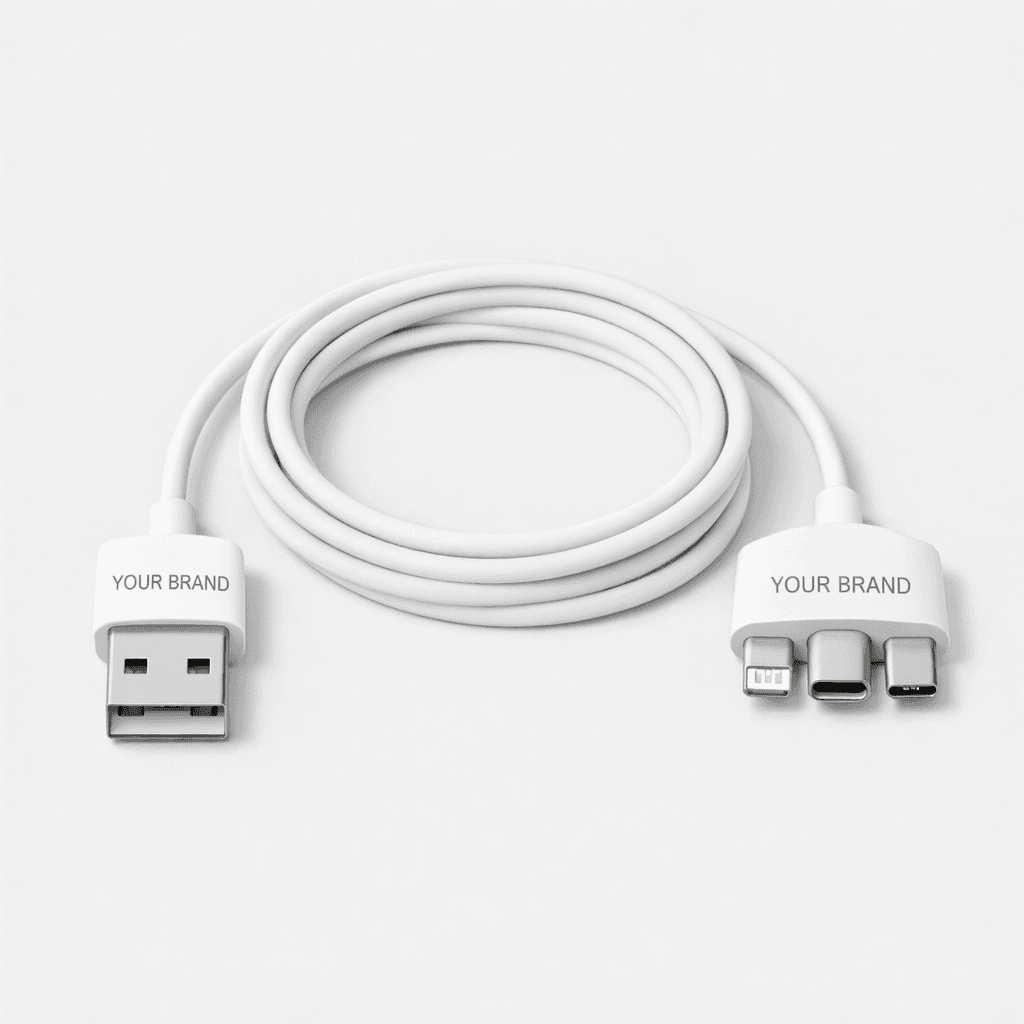
A private label universal USB charging cable is usually a multi-connector product designed to reduce the number of separate leads a user carries, but the word universal can hide important limitations. A cable may combine USB-C, Lightning-style and Micro-USB device tips while supporting different power levels, simultaneous charging behaviour or no data transfer at all. Performance depends on conductor construction, connector geometry, contact quality, wiring, length, strain relief and the source device used. A responsible sourcing brief names the exact input and output connectors, states whether each branch supports charging or data, defines tested electrical limits and avoids implying compatibility with every device or charging protocol.
The commercial case
Multi-tip charging cables fit phone-accessory shops, ecommerce stores, travel kits, offices, schools, event merchandise and corporate gifts. They offer an easy convenience story and a visible branding surface, but low-cost failures can damage trust quickly through slow charging, intermittent contact, hot connectors or broken branch joints. The commercial opportunity is strongest when the product is positioned for a specific use—such as a shared household lead, a travel backup or a branded giveaway—and its limitations are explicit. A cable should be compared by verified construction and performance, not braid appearance, connector count or an unsupported fast-charge label.
Market fit
Demand, buyers, and the brand angle
Customers use a wide mix of older and newer devices, which creates demand for multi-tip convenience while also making compatibility complicated. Some buyers expect a USB cable to transfer data, even when a branched design is intended only for charging. Others may assume all connectors can deliver the same power at once. Packaging should explain input type, output tips, charging-only or data capability, simultaneous-use limits, supported device categories and any required adaptor. Offer entry and premium versions around measurable differences in conductor size, connector housing, bend durability, length and tested power behaviour rather than decorative braiding alone.
What drives demand
- Households and workplaces commonly contain devices with more than one charging connector type.
- Travellers and commuters value a backup cable that reduces the number of separate leads carried.
- Phone-accessory cables are frequent replacement and add-on purchases when existing leads wear or go missing.
- Corporate and event buyers use practical branded electronics accessories as giveaways and kit components.
Likely customer groups
- Phone, computer and electronics-accessory retailers
- Online gadget, travel and lifestyle brands
- Corporate gift and event-merchandise suppliers
- Schools, offices, hotels and shared-device programmes
Recommended white-label angle
Build the brand around dependable everyday charging and honest compatibility. Use clear icons for each connector, label the input end, identify charge-only branches, and provide a compact guide to simultaneous use. Custom woven jackets, connector-shell colours, cable straps and retail cards can establish visual identity, but logos should not obscure connector orientation or required markings. A premium version can improve conductor construction, branch reinforcement and inspection rather than making broad speed promises. Freeze the bill of materials and electrical design because visually identical cables may use different wire gauges, contact plating or internal connections.
Build the brief
Specifications to settle before requesting quotes
Send every shortlisted supplier the same written brief. That makes quotations comparable and reduces substitutions after sample approval.
- Connector configuration
- List the exact source connector and every device tip, including connector orientation, branch length and whether adapters are fixed or removable.
- Charging capability
- Define tested voltage and current limits for each output and for simultaneous use without converting a laboratory maximum into a universal device promise.
- Data capability
- State which connector paths, if any, support data transfer and the tested mode; mark every charging-only branch clearly on packaging.
- Cable construction
- Control conductor material and cross-section, insulation, shielding where applicable, jacket material, outer diameter and finished length tolerance.
- Connector assembly
- Specify contact material or plating, shell construction, overmould dimensions, insertion fit and resistance to looseness or exposed edges.
- Branch joint
- Define internal anchoring, overmould, bend radius and pull resistance where the main cable divides into multiple tips.
- Strain relief
- Set relief length, flexibility and bend-cycle expectations at the source connector, branch joint and every device tip.
- Marking and packaging
- Approve connector icons, charge-versus-data notice, electrical limits, use warnings, model identity, barcode and cable storage method.
Customization ideas
- Brand-colour braided jacket with matching connector shells
- Laser-marked or moulded logo on the splitter body
- Reusable cable strap carrying the brand message
- Travel charging kit paired with a compatible wall adaptor or power bank after separate evaluation
Possible market positions
- 1. Clearly labelled multi-tip charging lead for mixed-device households
- 2. Compact travel backup cable with reusable storage strap
- 3. Reinforced everyday cable with controlled conductors and branch joints
- 4. Practical corporate charging accessory with restrained splitter branding
Supplier due diligence
Ask better questions. Inspect the answers.
Questions for potential suppliers
- 1What exact connector paths support charging and data, and what happens when two or more device tips are used simultaneously?
- 2What conductor material and cross-section are used for power and data lines, and how are substitutions prevented?
- 3Which voltage-drop, temperature-rise, continuity, short-circuit and charging-load checks are performed on finished cables?
- 4How many insertion, pull and bend cycles are used for connectors, the splitter and strain reliefs?
- 5Which charging protocols or device categories have been evaluated, and what compatibility limitations must be printed?
- 6Can you supply production-equivalent samples, a controlled bill of materials and retained references for inspection?
Quality-control checklist
- Verify input connector, output tips, cable and branch lengths, outer diameter, markings and pack configuration against the approved sample.
- Test continuity, polarity and absence of unintended shorts on every connector path using suitable equipment.
- Measure agreed voltage drop and temperature behaviour under defined loads for individual and permitted simultaneous outputs.
- Inspect connector fit, shells, contact alignment, overmoulds, splitter anchoring, exposed conductors and sharp or loose parts.
- Perform sampled bend, insertion and pull checks at each connector, strain relief and branch joint, then repeat functional tests.
- Confirm charge-only or data-capable labels, electrical limits, compatibility notices, barcode, pack count and carton protection.
Protect the order
Risks to resolve before production
Unsupported fast-charge language
Charging speed depends on the cable, source, device and protocol. State only performance supported for the exact configuration under defined conditions.
Undersized or substituted conductors
A cable can look identical while using smaller or different conductors that increase voltage drop and heat. Freeze construction and inspect production.
Charging and data confusion
Many multi-tip cables do not transfer data through every branch. Explicit packaging prevents customers from assuming functionality that is absent.
Early joint failure
The splitter and short branch leads experience repeated bending and pulling. Define anchoring and cycle tests instead of judging the braid alone.
Shipping and landed-cost planning
Charging cables are compact, but connectors can scratch each other, branch leads can kink and retail cards can bend when units are compressed loosely. Approve the coil diameter, cable tie or tray, connector protection, individual pack and carton orientation using the final length and jacket. Request packed unit dimensions, units per carton, master-carton dimensions and gross weight before comparing freight. Keep cables and packaging dry, and avoid prolonged crushing that permanently sets the bends. After representative transit handling, inspect connector shells, branch joints, packaging and sampled electrical performance before release.
Product sourcing FAQ
Questions founders ask before sourcing
Open any question to read the answer.
What makes a USB charging cable universal?
Usually it means the cable provides several common device connectors. It does not mean every phone, protocol, power level or data function is supported, so the exact configuration must be stated.
Can every connector charge at the same time?
That depends on the wiring, source and design. Ask the supplier for tested simultaneous-use behaviour and print any limits rather than assuming full output on every branch.
Do multi-tip charging cables transfer data?
Some do not, and others support data through only one connector path. The specification and packaging should identify each data-capable and charging-only tip.
What should be tested on a charging cable sample?
Check connector identity and fit, continuity, polarity, voltage drop, temperature under defined load, simultaneous behaviour, data paths, bend resistance and pull strength.
Can the cable be marketed as fast charging?
Only use a specific claim supported for the exact cable, source, device and protocol conditions. Avoid a broad promise based solely on a supplier label.
How can a brand reduce cable failures?
Freeze the conductors and connector assembly, retain an approved sample, test production electrically, inspect joints and strain reliefs, and prohibit unapproved component substitutions.