Product opportunity
Is vegetable chopper/slicer a good private-label product?
A private label vegetable chopper and slicer is a manual cutting system whose performance depends on the exact blade geometry, frame alignment, pushing mechanism, container, lid and hand-protection features. A long accessory list does not make a better product if inserts flex, blades loosen, produce jams or cleaning exposes users to sharp edges. Buyers should define the intended cuts and food types, specify every food-contact material, approve blade dimensions and interchangeability, and test the complete assembled tool under realistic preparation and cleaning conditions. The brief must also distinguish a push-down dicer, mandoline-style slicer, pull chopper or combination set because their hazards and quality checks differ.
The commercial case
Manual choppers appeal to kitchenware shops, supermarkets, ecommerce brands, caterers and households seeking faster, more uniform preparation. The tool is visually demonstrable and can support recipe content, but returns often arise from exaggerated speed claims, weak plastic, dull or unstable blades, difficult cleaning and confusion about attachments. A commercially sound product focuses on a small number of useful cuts, stable operation, accurate instructions and safe storage for unused blades. The brand should show what the tool can and cannot process instead of claiming that it replaces every knife or handles all foods without effort.
Market fit
Demand, buyers, and the brand angle
Buyers preparing onions, peppers, carrots and other common ingredients may value consistent dice and reduced repetitive knife work, while tougher or irregular produce can exceed a lightweight mechanism. Product demonstrations should use the same blade and food preparation described in the instructions and should not hide pre-cutting requirements. Container capacity, countertop grip and cleaning access matter as much as blade count. Build tiers around material strength, blade consistency, safer handling, replacement availability and useful storage rather than adding marginal attachments that increase confusion and carton volume.
What drives demand
- Households and food sellers value tools that can produce repeatable cuts for routine meal preparation.
- Manual tools work without electricity and can be demonstrated easily in stores and online video.
- Kitchen organisers and meal-preparation customers appreciate a container that captures cut ingredients.
- Gift sets and kitchenware bundles create add-on opportunities when instructions and storage are well designed.
Likely customer groups
- Kitchenware shops, supermarkets and ecommerce sellers
- Household and meal-preparation product brands
- Caterers and small food-preparation businesses using suitable manual tools
- Home and corporate gift-set companies
Recommended white-label angle
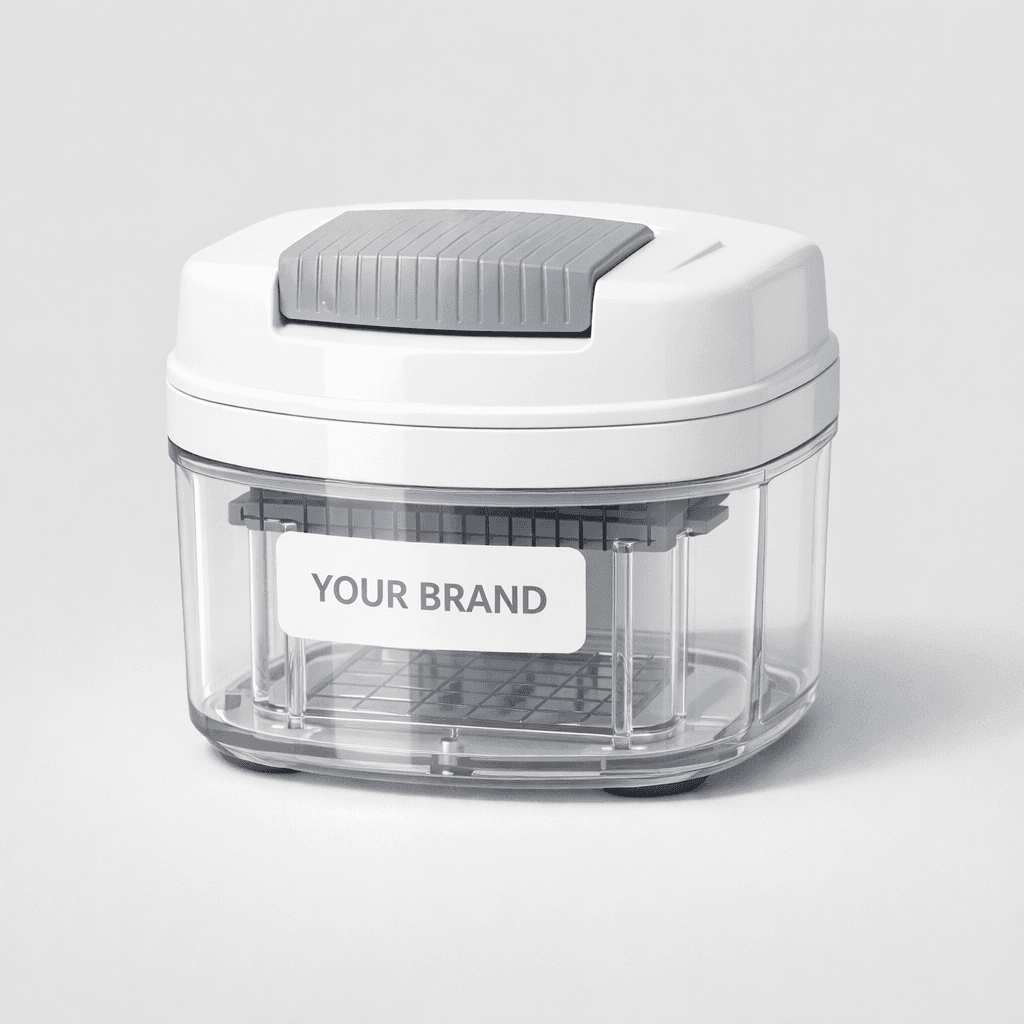
Position the chopper as a controlled preparation station. Use colour-coded blade frames, clear insertion arrows, a printed cut guide, guarded storage and instructions that show safe loading, pushing, cleaning and removal. Brand panels can sit on the container or lid away from food-contact and high-wear locking surfaces. A recipe card for soups, salads or meal preparation can create local relevance without making performance claims. For a premium range, prioritise stronger hinges, stable feet, an effective cleaning tool and replaceable blade modules instead of a decorative accessory count.
Build the brief
Specifications to settle before requesting quotes
Send every shortlisted supplier the same written brief. That makes quotations comparable and reduces substitutions after sample approval.
- Chopper mechanism
- Define push-down, sliding, rotating or pull action, intended foods, pre-cut size and force limits for the exact model.
- Blade modules
- List every dice, slice, grate or julienne insert with blade material, thickness, spacing, edge geometry and frame dimensions.
- Blade retention
- Specify locking method, insertion direction, release force and checks preventing a module from lifting or shifting during use.
- Food-contact components
- Identify materials and colourants for container, lid, pusher, blade frames and any component touching food, with market-relevant evidence.
- Container
- Set usable capacity, dimensions, wall thickness, lid fit, impact expectations and whether measurement markings are included.
- Stability and grip
- Define base footprint, feet or grip material and movement limits on representative dry and lightly damp worktops.
- Hand protection
- Approve pusher, guard, finger clearances, blade-storage method and instructions for foods that become too small to hold safely.
- Cleaning system
- Specify safe disassembly, included cleaning tool, inaccessible gaps, dishwasher claims if supported, drying and blade-handling warnings.
Customization ideas
- Brand-colour container accents with colour-coded blade frames
- Printed or moulded logo positioned away from locks and food contact
- Illustrated cut guide and locally relevant preparation card
- Guarded blade-storage case integrated into the retail pack
Possible market positions
- 1. Focused onion-and-vegetable dicer with two genuinely useful blade sizes
- 2. Stable meal-preparation station with container and guarded blade storage
- 3. Easy-clean manual chopper supported by illustrated safety instructions
- 4. Kitchen preparation gift set with separately evaluated complementary tools
Supplier due diligence
Ask better questions. Inspect the answers.
Questions for potential suppliers
- 1What mechanism and blade modules are included, and which foods, maximum sizes and pre-cutting steps are recommended?
- 2What are the blade material, hardness or process specification, thickness, spacing and sharpness-control method?
- 3How are blade frames, hinges, locks, pushers and container impact tested over repeated cycles?
- 4Which documents support the intended food-contact use of every plastic, metal, coating and colourant in the exact product?
- 5How do users remove, clean, dry and store each sharp module without direct contact with cutting edges?
- 6Can you provide production-equivalent samples, retained references and spare modules using the final materials and moulds?
Quality-control checklist
- Verify included modules, blade pattern, container capacity, dimensions, weight, material identification and accessory count.
- Inspect blade straightness, spacing, burrs, sharpness consistency, frame cracks, looseness and secure retention in the tool.
- Run controlled cutting comparisons on specified representative foods and record jamming, force, cut consistency and damage.
- Cycle hinges, locks, pushers and modules, then inspect wear, alignment, cracks and continued blade retention.
- Test base stability on representative surfaces and confirm guards and clearances keep hands away when instructions are followed.
- Disassemble, clean, dry and reassemble sampled units; verify cleaning tools, warnings, branding, pack count and carton protection.
Protect the order
Risks to resolve before production
Loose or inconsistent blades
Poorly fixed or misaligned blades can shift, bend or produce uneven cuts. Control the insert and frame construction and inspect retention.
Hand-contact hazard
Small produce, cleaning and blade changes can expose fingers. Provide suitable guards, storage and clear handling instructions.
Brittle plastic failure
Lids, hinges, frames or containers can crack under pushing force or impact. Specify materials and repeat representative cycle and drop checks.
Overbroad performance claims
One tool will not process every food or replace every knife. State food, size and preparation limits and demonstrate only tested uses.
Shipping and landed-cost planning
Vegetable choppers combine sharp metal inserts with plastic frames and containers that can crack or scratch if packed poorly. Every blade should be restrained or guarded so it cannot move through the individual pack, and attachments should not load fragile lids or hinges. Obtain final retail-pack dimensions, units per carton, master-carton measurements, gross weight and stacking arrangement before confirming freight. Conduct representative drop and vibration handling, then inspect containers, locks, hinges, blade frames and accessory count. Keep all food-contact surfaces clean and protected from dust, moisture and odours during storage and shipment.
Product sourcing FAQ
Questions founders ask before sourcing
Open any question to read the answer.
What type of vegetable chopper should a buyer source?
Choose the mechanism around the intended foods and cuts. Push-down dicers, mandoline slicers, pull choppers and combination sets have different performance and safety requirements.
Does a larger blade set make a better chopper?
Not necessarily. A smaller set of secure, consistent and useful modules can provide more value than many poorly identified attachments.
What materials should be specified?
Identify every food-contact plastic, metal, coating and colourant, together with evidence relevant to the intended use and destination market.
How should blade sharpness be checked?
Use a consistent method and representative foods, then compare cutting force, jamming and cut quality across samples while also inspecting burrs and blade retention.
Can the chopper be described as safer than a knife?
Avoid a broad safety promise. The tool still contains sharp blades; safe use depends on guards, stable assembly, correct food preparation, cleaning and following instructions.
How can a buyer reduce product returns?
Limit the offer to useful modules, define suitable foods and sizes, control blade and plastic construction, test cycles, and provide clear assembly, use and cleaning guidance.